
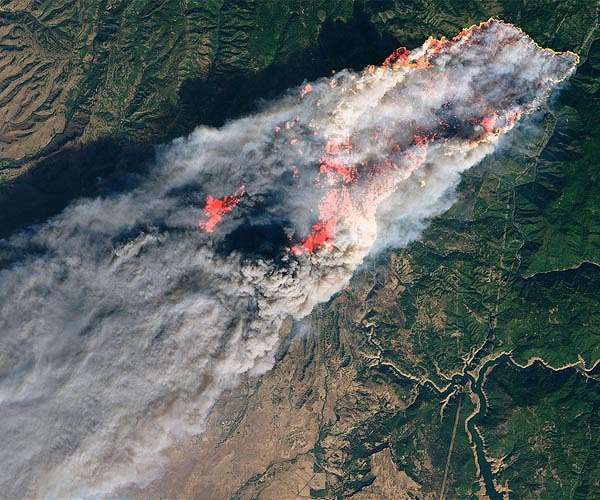
Smoky summers in the west can now be linked to a worsening trend of wildfire smoke impacting air quality clear into September, according to new research.
University of Utah researchers on Friday published a study in Environmental Research Letters showing that trends in poor air quality events will affect an area from the Pacific Northwest to the Rocky Mountains in the years to come.
"In a big picture sense, we can expect it to get worse," lead study author Kai Wilmot said in a press release
"We're going to see more fire area burned in the Western U.S. between now and in 2050. If we extrapolate our trends forward, it seems to indicate that a lot of urban centers are going to have trouble in meeting air quality standards in as little time as 15 years," said Wilmot, a doctoral student in the Department of Atmospheric Sciences.
The study combined multiple sources of information on atmospheric composition, wildland fire emissions and fire area burned.
Wilmot looked at trends between 2000 and 2019 to see if they correlated with summer wildfires. He found consistent trends and that, within those trends, there were different spatial patterns in August than in September.
Sensors indicated worse air quality during the month, along with more wildfire events.
"That's pretty dramatic that extreme events are strong enough to pull the mean up so that we're seeing an overall increase in particulate matter during August across much of the Pacific Northwest and portions of California. The Pacific Northwest seems like it's just really getting the brunt of it," Wilmot said.
By September, researchers found, wildfire activity slows in British Columbia and shifts to the Rocky Mountains, along with the smoke.
Declines in September air quality in Wyoming and Montana were also linked to wildfire smoke.
"Thus far, the 2020 fire season has provided an exceptionally clear indication of the cost to human wellbeing should the trends we have identified persist over the coming decades," researchers wrote in the study.
According to the American Lung Association's annual "State of the Air" report, more than 40% of Americans live with unhealthy air.
The report showed that Western states continue to experience record-breaking highs in particle pollution due to smoke from wildfires. Known as PM2.5, these microscopic particles can trigger asthma attacks, heart attacks, strokes and cause lung cancer.
This year, California designated $536 million for wildfire prevention, including $125 million from the Greenhouse Gas Reduction funds and $411 million from the state's General Fund.
The announcement came after the California Department of Water Resources last week marked 2021 as the third-driest water year on record in the state.
Controlled bushfire cloaks Sydney in hazardous smoke
Sydney (AFP) May 2, 2021 –
Sydney was enveloped in a thick bank of hazardous bushfire smoke Monday, forcing authorities in Australia's largest city to scale back controlled forest burning nearby.
Ferries were cancelled and the city's five million residents were told to stay indoors if necessary, as air pollution levels spiked.
Levels of hazardous PM 2.5 pollution — particles that can seep deep into the lungs and cause respiratory illnesses — were among the worst in the world at more than 190 on the air quality index.
Australia's fire services regularly try to carry out "hazard reduction burning" outside summer months, clearing the forest floors of debris that can fuel wildfires.
But they were forced to scale back plans for further burns Monday as pollution reached hazardous levels and some union groups told workers to drop tools if the smoke was too much.
"Light winds and an overnight inversion has resulted in smoke settling in low-lying residential areas," the fire service said.
The smoke was forecast to clear as the day progresses.
Fires ravaged much of eastern Australia in 2019-2020, killing 33 people, destroying more than 3,000 homes and enveloping Sydney and other cities in a soup of smoke and ash for months on end.
Climate change is believed to be making fire seasons longer and more dangerous, as well as limiting the timeframe when controlled burns can be carried out safely.
