
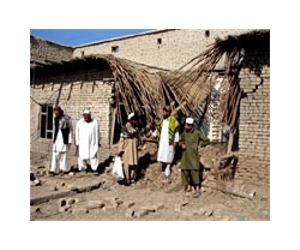
Missiles fired from US drones Tuesday killed at least six militants in a restive Pakistani tribal area bordering Afghanistan, security officials said.
"US drones fired two missiles on a militant vehicle parked outside a compound. At least six militants were killed and three others were wounded," a senior security official told AFP.
"The compound, being frequented by militants recently, was also destroyed in the attack," he added.
Another security official and two intelligence officials confirmed the missile strike and death toll.
The official said it was not immediately clear whether any "high value target" was present at the time of the attack, which took place in the suburbs of Miranshah, the main town in the lawless tribal district of North Waziristan.
Residents said that militants had started sifting through the debris and removing the bodies.
Militants immediately cordoned off the area around the destroyed vehicle and the compound, a local tribesman told AFP on condition of anonymity.
US drone attacks routinely target Taliban and Al-Qaeda commanders in Pakistan's semi-autonomous tribal belt, which Washington calls the global headquarters of Al-Qaeda and the most dangerous region on Earth.
A US drone strike in Miranshah in February killed Mohammed Haqqani, a brother of Al-Qaeda-linked warlord Sirajuddin Haqqani, whose network is fighting against US and local forces in neighbouring Afghanistan.
North Waziristan, which is infested with multiple militant factions, is increasingly the focus of the US drone war against Al-Qaeda and Taliban fighters active in Afghanistan.
North Waziristan's prominence in the covert drone war has grown since a Jordanian Al-Qaeda double agent blew himself up killing seven CIA employees in a neighbouring Afghan province in December.
Under US pressure, Pakistan's military claims to have made big gains against Taliban and Al-Qaeda strongholds over the past year, following major offensives in the northwestern district of Swat and in South Waziristan.
More than 830 people have been killed in more than 90 US strikes in Pakistan since August 2008, with a surge in the past year as President Barack Obama puts Pakistan at the heart of his fight against Al-Qaeda.
earlier related report
Alleged private spy ring prompts wider US probe: Pentagon
Washington (AFP) March 23, 2010 –
Defense Secretary Robert Gates has ordered a study of US "information operations" after a Pentagon official allegedly set up a spy network with private contractors, a spokesman said on Tuesday.
A small team of senior military and defense officials will "conduct a quick look assessment" and report their findings within 15 days, press secretary Geoff Morrell told a news conference.
He said the assessment would look at the role of private contractors in what the military calls information operations, which covers a range of efforts including psychological warfare and public relations.
The study was "designed to provide the secretary with a factual baseline from which to determine whether or not systematic problems exist and if so, proper scope and focus of subsequent corrective action," Morrell said.
He said a separate Pentagon investigation was examining allegations that a Defense Department official had hired private contractors in an unofficial spy ring to help with manhunts of militants in Afghanistan and Pakistan. The official reportedly set up the network under the guise of an information-gathering program.
"There is an ongoing investigation by investigative bodies in this building including the IG (Inspector General) in the particulars of that case," Morrell said.
The allegations were reported first in The New York Times.
Some US officials told the paper they were concerned that the Defense Department employee, Michael Furlong, was running an "off-the-books" spy operation, and were not sure who condoned and supervised his work.
It was possible that Furlong's network might have been improperly financed by diverting money from a program designed to gather information about the region, according to the paper.
Gates on Monday said the role of private contractors in collecting intelligence in the field was "something I need to know more about."
Congress approved about 520 million dollars for "information operations" for fiscal 2010 and takes "a great deal of interest" in the subject, Morrell said.
A declassified Pentagon document written in 2003 stressed the importance of information operations, referring to efforts to plant stories in foreign media and plans to destroy enemy computer networks if necessary.
The document, "Information Operations Roadmap," was signed by former defense secretary Donald Rumsfeld and released in 2006.
Share This Article With Planet Earth
