
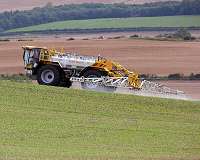
Pharmaceutical giant Bayer announced Friday plans to invest five billion euros ($5.6 billion) over the next decade in a new generation of herbicides and promised more transparency after the Monsanto "watch list" scandal.
Since it acquired Monsanto for $63 billion in 2018 — one of the largest deals in German corporate history — Bayer has been lumbered with a massive burden of health-related lawsuits because of Round Up, the American company's glyphosate herbicide.
Monsanto has also come under fire after it was revealed that it kept lists of key pro- or anti-pesticides figures in at least seven EU countries.
Amid the spiralling row over glyphosate, Leverkusen-based Bayer said it would offer more "transparency" during the process of renewing the licence of glyphosate in the European Union.
The German company insisted however that glyphosate "will continue to play an important role in agriculture and in Bayer's portfolio".
At the same time, Bayer said it is "committed to offering more choices for growers and will invest approximately five billion euros in additional methods to combat weeds" in the next decade.
It also aims to "reduce the environmental impact by 30 percent by 2030" of its agricultural products, it said.
These measures, Bayer said, "address questions and concerns" it has heard "following its acquisition of Monsanto."
Round-Up has been the subject of three costly judgements in California in recent months and is now the subject of more than 13,000 claims in the United States.
In the last year, Bayer has seen around 40 percent wiped off its share price.
Glyphosate is classified as a "probably carcinogenic" by the World Health Organisation (WHO), but the EU in December 2017 renewed the licence of the weedkiller across Europe for five years.
The licence runs until December 15, 2022 and any request for renewal must be submitted by the end of the year.
In France, Bayer is under investigation for allegedly keeping lists of key pro- and anti-pesticides figures drawn up by a PR agency on behalf of Monsanto.
Last month, Bayer admitted that Monsanto kept similar lists in at least seven EU countries.
AFP has filed a complaint with a French data protection regulatory body because some of its journalists were on the list.
German railways to stop using glyphosate on tracks
Berlin (AFP) June 14, 2019 –
German state-owned rail operator Deutsche Bahn is to stop using glyphosate on its tracks and is looking for substitutes to replace the controversial weedkiller, one of its board members said in an interview Friday.
"We want to set up a research project to find effective ways to operate our 33,000 kilometres (20,500 miles) of network without glyphosate to be environmentally friendly," infrastructure chief Ronald Pofalla told the weekly business magazine WirtschaftsWoche.
The rail operator is Germany's largest user of glyphosate and buys nearly 65 tonnes of the herbicide per year to stop weeds from propagating on its tracks.
German Environmental Minister Svenja Schulze welcomed the initiative.
"Glyphosate kills insects which is why we are going to ban it in Germany," she told WirtschaftsWoche.
The World Health Organization classifies glyphosate as "probably carcinogenic".
In December 2017, the European Union renewed the licence of glyphosate across Europe until 2022.
Among the possible alternatives Deutsche Bahn is looking at to kill off the weeds are "hot water, electric shocks or UV lights", according to WirtschaftsWoche.
One of the best-known glyphosate-based products is the weedkiller Roundup manufactured by Monsanto, the US company recently taken over by Germany's Bayer, and which has been at the centre of several health-related lawsuits.
Last year, Deutsche Bahn transported a record 148 million people on its main lines in Germany while across Europe 2.6 billion passengers travelled on trains belonging to the red-and-white-liveried company.
