
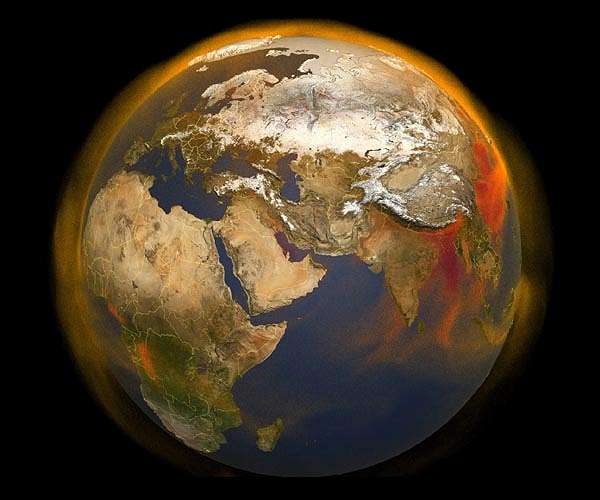
The UN unveiled on Friday a satellite-based system to detect methane emissions as part of efforts to cut down on the major contributor to global warming.
The Methane Alert and Response System (MARS) was announced by the UN Environment Programme during the COP27 climate summit in the Egyptian seaside resort of Sharm el-Sheikh.
Methane, emitted by leaks in fossil fuel installations as well as from other human caused sources like livestock farming and landfills, is responsible for roughly 30 percent of the global rise in temperatures to date.
Dozens of countries last year pledged to act to cut pollution from the potent greenhouse gas.
MARS will use data from global mapping satellites to detect methane "hot spots" and large plumes of the gas, and identify its source, the UN Environment Programme said in a statement.
UNEP would then notify governments and companies about the emissions "so that the responsible entity can take appropriate action."
"Reducing methane emissions can make a big and rapid difference, as this gas leaves the atmosphere far quicker than carbon dioxide," said UNEP Executive Director Inger Andersen.
US climate envoy John Kerry said cutting methane was the "fastest opportunity" to help the world reach the goal of limiting warming to 1.5 degrees Celsius.
US targets fossil fuel 'super-emitters' of methane
Sharm El Sheikh, Egypt (AFP) Nov 11, 2022 – On the hunt for the methane "super-emitters", US President Joe Biden on Friday unveiled a plan to plug oil and gas leaks and tighten regulation as several global emitters vowed to step up efforts to slash pollution of the powerful greenhouse gas.
Methane, released from the oil and gas, waste and agriculture sectors as well as through natural processes, is responsible for roughly 30 percent of the global rise in temperatures to date.
Dozens of countries have signed up to cutting their emissions of the short-lived but potent gas by a third this decade and Biden said this could be "our best chance" to meet the Paris climate deal's more ambitious goal of limiting warming to 1.5 degrees Celsius.
"We have to make vital progress by the end of this decade," he told an audience at COP27 in the Egyptian seaside resort of Sharm el-Sheikh.
With recent data showing methane concentrations in the atmosphere made their biggest increase on record in 2021, the United States, the European Union, Japan, Canada, Norway, Singapore and Britain signed an agreement committing to "immediate action to reduce the greenhouse gas emissions associated with fossil energy production and consumption".
They also vowed to minimise flaring — burning off unwanted natural gas from oil and gas wells — and to minimise methane and carbon dioxide "across the value chain to the fullest extent practicable, while also working to phase down fossil fuel consumption", according to a statement from the EU.
– 'Hot spots' –
Biden pledged to invest more than $20 billion in cutting emissions in the United States, including improving equipment and capping leaks in the oil and gas industry.
He also touted "strong regulatory actions" from the country's Environmental Protection Agency, which, if finalised, would toughen up standards for methane and other harmful air pollutants.
This was "especially from super emitters", he said, referring to a programme that would require operators to respond to credible third-party reports of high-volume methane leaks.
Earlier this week, the newly-launched TRACE satellite monitoring project said the top 14 largest emitters are all oil and gas extraction sites.
And of those, the biggest emitter on the planet is the Permian Basin in Texas — one of the largest oilfields in the world — said former US vice president Al Gore, a project founder.
On Friday, the UN Environment Programme unveiled its satellite-based Methane Alert and Response System (MARS), which will use data from global mapping satellites to detect methane "hot spots" and large plumes of the gas, and identify their source.
– 'Game changer' –
Biden said the measures announced Friday would enable the US to reduce its emissions from covered sources by 87 percent below the levels of 2005, by 2030.
At last year's COP26 climate summit in Glasgow, more than 100 nations agreed under the Global Methane Pledge to reduce emissions 30 percent by 2030, spearheaded by the US and European Union.
But several major methane emitters — including China, Russia, Iran and India — failed to sign.
That figure has grown to 130, Biden said Friday, adding it was a "game changer".
Governments have zeroed in on emissions of methane, which lingers in the atmosphere only a fraction as long as CO2, but is far more efficient at trapping heat. Levels of the gas are their highest in at least 800,000 years.
European Commission President Ursula von der Leyen said countries working together could reduce warming by 0.1C by mid-century, adding "every fraction of a degree counts in our fight to preserve our planet for future generations".
Rachel Cleetus, lead economist at the Union of Concerned Scientists' climate programme, said the swathe of new announcements on methane "are critical" to addressing planet-heating methane pollution.
"We urgently need better tracking of methane emissions and stronger rules to reduce these emissions," she said.
The International Energy Agency has decried the enormous amount of methane that leaks from fossil fuel operations, estimating the amount lost last year globally was broadly similar to all the gas used in Europe's power sector.
In October, NASA said a methane plume about two miles (3.3 kilometres) long was detected southeast of Carlsbad, New Mexico, in the Permian Basin.
