
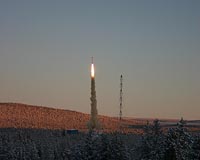
During the last week two sounding rockets with microgravity experiments were successfully launched from Esrange Space Center, the operational space facility of the Swedish Space Corporation (SSC). The Brazilian motor VSB-30 was used during both flights.
The TEXUS project is a sounding rocket program with the primary aim to investigate the properties and behaviour of materials, chemicals and biological substances in a microgravity environment.
The program started in 1977 and is a part of the European programme for Life and Physical Sciences and applications using the International Space Station (ELIPS) as well as of the German programme 'Forschung unter Weltraumbedingungen'.
"Both launches went very smooth and all systems functioned as planned", said Otfried Joop, the Texus project manager at DLR.
"The payloads were back at Esrange very quickly after the flights and the de-integration work of the experiments shows excellent conditions of the experiment modules. According to preliminary analysis, the scientific results are very good".
The Texus program is carried out jointly by the German Space Agency (DLR), the European Space Agency (ESA), EADS Astrium and the SSC. The experiments for flight 46 and 47 were financed by the European Space Agency (ESA) and DLR.
Share This Article With Planet Earth
