
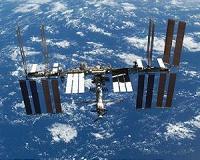
A leak of a toxic substance on Wednesday forced astronauts to evacuate the American section of the International Space Station, Russia's space agency said Wednesday.
The "toxic substance was emitted from a cooling system into the station's atmosphere" in the US segment of the station, the agency said in a statement.
"At present the American segment has been evacuated and the crew is safely located in the Russian segment," the statement said. The American segment has been sealed off.
A representative of the Russian mission control centre told Russian news agencies that the substance is ammonia. The accident could also delay the departure of the US SpaceX cargo ship Dragon, which brought supplies earlier this week.
Fixing the leak may also require an emergency spacewalk, he added.
Senior Russian space official Maxim Matyushin said their colleagues at America's NASA were working on dealing with the issue.
The International Space Station is a rare area of US-Russian cooperation that has not been hit by the crisis in Ukraine, which has prompted Washington to impose sanctions on Moscow.
In total 16 countries work on the ISS, whose cost is mainly shouldered by the United States.
Since NASA phased out the space shuttle system in 2011, it depends entirely on Russia to send its astronauts to the ISS.
NASA Status Update
The Expedition 42 crew members are safe and in good shape inside the Russian segment of the International Space Station following an alarm in the U.S. segment at about 4 a.m. EST.
Flight controllers in Mission Control at NASA's Johnson Space Center in Houston saw an increase in pressure in the station's water loop for thermal control system B then later saw a cabin pressure increase that could be indicative of an ammonia leak in the worst case scenario.
Acting conservatively to protect for the worst case scenario, the crew was directed to isolate themselves in the Russian segment while the teams are evaluating the situation. Non-essential equipment in the U.S. segment of the station was also powered down per the procedures.
In an exchange at 7:02 a.m. with Expedition 42 Commander Barry Wilmore of NASA, spacecraft communicator James Kelly said flight controllers were analyzing their data but said it is not yet known if the alarm was actually triggered by a leak or whether the situation was caused by a faulty sensor or by a problem in a computer relay box that sends data and commands to various systems on the station.
