
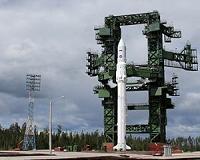
A defect in the drainage valve of the liquid oxygen tank detected during pre-launch tests led to cancellation of the first test launch of the light-class Angara carrier rocket 19 seconds prior to the engine refueling, experts told Interfax-AVN after probing an emergency during Angara's launch on Monday.
"One needs to understand what Angara means. It is new engines, a new control system. In other words, trials are needed in order to fine-tune everything. There is no room for any frenzy. We should not take any risks. It has taken us quite long to build this rocket. It will certainly fly into space, but more tests should be conducted first. Its launch has been cancelled because a malfunction was detected. The malfunction was assessed by its own system," Russian Deputy Prime Minister Dmitry Rogozin told reporters in Uglegorsk on Tuesday.
The cause for the automatic shutdown of the Angara liftoff from Plesetsk Cosmodrome is "the fall of pressure in the oxidizer tank's spherical balloon", which is not a part of the first-stage engine structure, Interfax-AVN reports a spokesperson for the NPO Energomash company which designed the engine as saying in a statement on Tuesday.
In the course of the production process, all engines undergo firing tests before being shipped to the customer. Angara's engine flawlessly passed all final tests on the engine test standard at the Energomash facilities, the statement said.
Rogozin said that he doesn't know when the next launch will take place. "I think it will take us weeks to return the Angara launch vehicle to its launch pad," he said, Interfax reports.
Reports said earlier that Angara's first test launch, scheduled for June 27, was cancelled by the rocket computer automatically a few seconds before launch.
Angara has four varieties that range from the light-class version with a lifting capacity of 1.7 to 3.7 tons to the heavy-class version with a lifting capacity of up to 28.5 tons. All versions are based on the versatile rocket module, powered with the RD-191 engine which uses environmentally friendly fuels: kerosene and liquid oxygen.
