
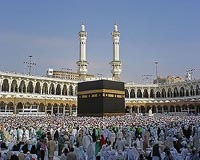
The United Arab Emirates has said everyone going on the annual Muslim pilgrimage to Saudi Arabia must be vaccinated against swine flu before leaving the country, a newspaper reported on Tuesday.
"We have decided to make it mandatory for the hajj pilgrims to take the swine flu vaccine in order to protect them, protect their families and protect all those around them," Mahmoud Fikri, chairman of the National Committee for Combatting Swine Flu, was quoted as saying by The National.
This year's hajj, in the last week of November, will see some three million pilgrims descend on the Muslim holy city of Mecca, including around a million from within Saudi Arabia itself.
The UAE on Monday launched a campaign to increase awareness about A(H1N1) and the importance of vaccination, the newspaper said.
Members of the UAE's official hajj delegation were vaccinated at Abu Dhabi airport on Monday before leaving for Saudi Arabia.
Pilgrims can be inoculated free of charge at four centres in Dubai and 30 elsewhere in the UAE, the newspaper said.
They can also have pre-pilgrimage medical checkups at the centres, where any necessary medication will also be provided free during the hajj season.
"We cannot have the vaccine present everywhere and in every medical centre, but we will make sure pilgrims are told where to go," Fikri said, according to The National.
Pilgrims must be able to present a yellow International Certificate of Vaccination in order to make the pilgrimage, the paper added.
Although anti-swine flu vaccine takes 15 days to become effective, it said that there is no deadline for inoculations.
earlier related report
US sick leave policy toughens swine flu fight: senator
Washington (AFP) Nov 10, 2009 –
Swine flu is causing "an American emergency" as employees who lack paid sick leave go to work despite being ill and spread the disease, US lawmakers were told Tuesday.
The A(H1N1) virus "is causing an emergency for workers and families across the country," Senator Chris Dodd told a Senate subcommittee hearing on paid sick leave in a time of pandemic flu.
The United States is the only developed nation without a national policy on paid sick leave, Dodd said.
Most government workers, including US legislators, have paid sick leave, but since it is not mandatory some 57 million US private sector workers, including many in low-paid jobs and tens of thousands working in school systems, lack the benefit.
For them, contracting the swine flu "means you have a choice: either go into work sick and risk infecting your co-workers or stay home and lose a day's pay," Dodd said.
The senator has introduced legislation to give US workers paid sick days if they or a family member come down with swine flu.
As the nation struggles to emerge from a punishing recession and double-digit unemployment, many Americans cannot consider taking unpaid sick leave, said Dodd.
"We're in the company — and I say this respectfully of these countries — of Lesotho, Liberia, Papua-New Guinea and Swaziland. Those countries and the United States are the five that don't have paid sick leave," Dodd said.
"Five nations, four of whom are struggling economies, barely surviving as nation-states, and the richest country in the world," he told a hearing in the Senate health, education, labor and pensions subcommittee.
A person who goes into work when they have swine flu will infect 10 percent of their co-workers, according to data from the Centers for Disease Control and Prevention (CDC), which has repeatedly urged people to stay at home if they fall ill with flu-like symptoms.
"If paid sick leave had been a reality when this pandemic began, we would be in better shape," Dodd said.
The A(H1N1) flu has infected as many as 5.7 million people in 48 US states and claimed 672 lives, including at least 129 children, according to CDC data.
Share This Article With Planet Earth
