
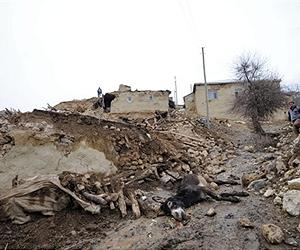
Survivors of a killer earthquake in eastern Turkey sought to resurrect shattered lives Tuesday as experts warned the disaster was only a reminder of worse tremors threatening the country.
Often terrified anew by aftershocks, residents of remote villages devastated in Monday's tremor scrambled to collect any remaining valuables from the wreckage of mud-brick homes as earth-moving machines began clearing the rubble.
Survivors mourned not only the 51 dead, but also the loss of large numbers of livestock, their only livelihood in villages nestled among hills in an impoverished, mainly Kurdish area in Elazig province.
In Okcular, the worst-hit village, a woman used a baby bottle to give milk to two young calves wrapped in blankets, while several men fed cows, still trapped under the debris, with their hands.
"Stock breeding is the only thing we rely on, but 70 percent of our animals are dead," said Nurettin Yildirim, the elderman of the neighbouring Yukari Demirci village.
The pre-dawn tremor, which had a magnitude of 6.0, razed dozens of mud-brick houses in five villages, killing whole families in their beds. About 70 people were injured.
Survivors spent their first night in tents or huddled around bonfires, but few were able to sleep as a flurry of aftershocks continued to rattle the region, the most powerful of which had a magnitude of 5.5.
Almost all the dead were buried by Tuesday as soldiers and Red Crescent workers set up mobile kitchens and distributed relief supplies.
Officials and experts lamented that shoddy construction exacerbated the disaster, as has been the case with other quakes in the past.
"The magnitude was only 6.0 but 51 lives were lost. The disaster is not in the quake, but in the mud-bricks," the Radikal daily wrote on its front page.
In Yukari Demirci, for instance, 33 mud-brick houses either collapsed or were severely damaged.
The only three houses that stayed intact in the village were cement structures built with government support to replace houses damaged by a 2003 tremor in the region.
Prime Minister Recep Tayyip Erdogan Monday ordered the public construction company to immediately start work to rebuild the homes of the victims.
Crossed by several active fault lines, Turkey is frequently jolted by earthquakes, but construction quality — crucial to minimize loss of life — remains a major problem.
"The number of deaths is related directly to the construction quality," said Okan Tuysuz, a geologist from Istanbul University. "Unfortunately, Turkey is a country poorly prepared for earthquakes in terms of building quality."
Many of the some 20,000 deaths in two powerful tremors that devastated northwestern Turkey in 1999 were also blamed on sub-standard buildings, the result of widespread corruption plaguing the construction sector.
Scientists expect a huge quake to hit Istanbul in the next 30 years, warning of massive destruction in a sprawling city of some 12 million, where migration from rural areas has led also to widespread illegal construction.
Tighter building rules were introduced in Turkey after the 1999 tragedy, but millions of old buildings need to be reinforced.
Istanbul Mayor Kadir Topbas said contingency plans were based on a scenario that a powerful quake in the city would flatten 50,000 buildings and claim 30,000 lives.
Share This Article With Planet Earth
