
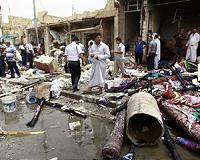
A suicide bomber detonated an explosives-rigged vehicle at a security forces position north of Baghdad on Friday, killing 15 people, police and a doctor said.
The attack south of the sensitive shrine city of Samarra in Salaheddin province, where militants have overrun the state capital and a swathe of other territory, also wounded 25 people.
Samarra, 15 kilometres (nine miles) north of where the attack took place, is home to the revered Shiite Al-Askari shrine, which was bombed in February 2006, sparking a bloody Sunni-Shiite sectarian war.
The position was occupied by a mix of Iraqi soldiers and civilians who have volunteered to fight a major jihadist-led militant offensive that has overrun chunks of five provinces.
Security forces folded under the weight of the initial onslaught, in some cases shedding uniforms and abandoning vehicles to flee, prompting the government to announce it would arm and equip people who volunteered.
While government forces have since performed better, they are still struggling to carry out effective offensive operations against the militants.
Iraq PM says 'will never give up' on third term bid
Baghdad (AFP) July 04, 2014 –
Iraqi Prime Minister Nuri al-Maliki insisted Friday on a third term in office, defying growing domestic and foreign pressure for him to step aside.
"I will never give up on my candidacy for the post of prime minister," the 64-year-old said in a statement.
Maliki's State of Law coalition won far more seats than anyone else in April elections, but the premier is accused by critics, even from his own Shiite Arab majority, of steering the country towards all-out sectarian war.
"The State of Law coalition is the biggest bloc and has the right to the premiership and any other side has no right to put conditions, because putting conditions means dictatorship and we strongly reject this," the defiant premier said.
Maliki, who once pledged he would not seek a third time, took a hit last month when jihadist-led Sunni militants overran the country's second city Mosul virtually unimpeded and took control of large swathes of territory in five provinces.
His opponents argue that he is to blame because he has allowed corruption and sectarianism to flourish during his time in office fostering anger in the Sunni Arab minority and pushing the Kurds along the road to independence.
"The withdrawal from the battlefield in the face of terrorist organisations that are enemies of Islam and of humanity, would be an abrogation of legitimate national and moral responsibility," Maliki said.
Western powers, as well as Iraq's top Shiite cleric, have stressed that pressing on with the political process by agreeing on a speaker, president and government should be the top priority and a necessary basis for tackling the jihadists.
But Maliki has emphasised the military option since the militant onslaught.
"I have made a promise to God that I will continue to fight by the side of the armed forces and volunteers until the final defeat of the enemies of Iraq," he said.
