
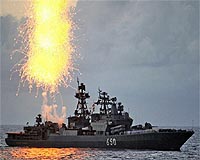
Russian warships on Tuesday wrapped up two days of joint exercises with Venezuelan navy vessels that were widely seen as a pointed challenge by Moscow to traditional US influence in Latin America.
The maneuvers took place in Venezuela's territorial waters in the Caribbean and involved a nuclear-powered cruiser, Peter the Great, and three other Russian ships, and three Venezuelan frigates.
It marked the first time since the end of the Cold War that a Russian fleet had been in Latin America, often described as the "backyard" of the United States.
Venezuelan state television network VTV showed images of the combined flotilla, and said the Russian vessels would leave Venezuelan waters later Tuesday for the return voyage home.
Russian and Venezuelan officials presented the exercise, called "VenRus 2008", as an important step in closer Caracas-Moscow ties.
The two countries plan further joint training operations, including one that would see Venezuelan military ships pairing with Russian ones in the North Sea.
Venezuelan President Hugo Chavez, whose strong anti-US stance has precluded him from acquiring US weapons, has turned to Russia for deals worth 4.4 billion dollars over the past three years to supply him with radars, 24 Sukhoi-30 planes, 50 helicopters and 100,000 Kalashnikovs.
The United States dismissed the significance of the presence of the Russian ships, with Secretary of State Condoleezza Rice saying before the exercise that the presence of "a few Russian ships is not going to change the balance of power."
Several observers suggested Russia was carrying out the maneuvers in retaliation for spreading US influence in its former Soviet-era sphere of control.
They noted US plans to deploy an anti-missile defense "shield" in eastern Europe and Washington's criticism over Russian military actions in Georgia in August.
Russian President Dmitry Medvedev, who made a trip to Venezuela last week just before the start of the joint exercise, said he wanted to restore "privileged relations" with Latin American countries that had close ties to the Soviet Union in the Cold War, when fierce superpower rivalry played out in the region.
However he denied the naval activities were designed to be an affront to the United States, describing them as not aimed at any third nation but rather focused on anti-terrorist and anti-narcotics operations.
Chavez, for his part, was in a jocular mood when he toured a Russian destroyer with Medvedev, telling accompanying reporters: "We're going to Cuba!"
