
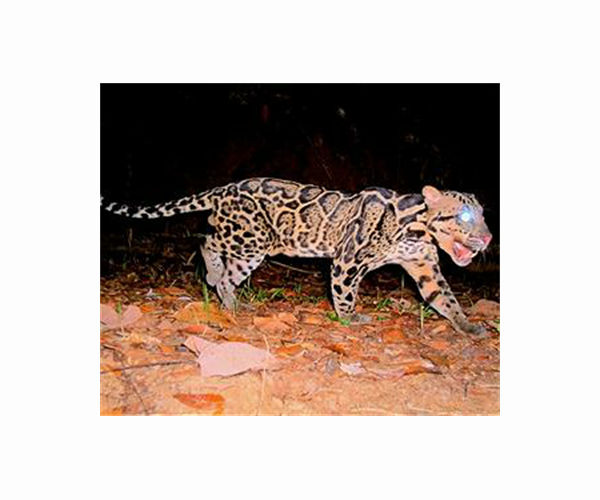
An endangered leopard captured in Iraq's mountainous north had its hind leg amputated on Friday following a trap-inflicted wound, an AFP photographer said.
The Persian leopard, taken in a day earlier in Iraq's autonomous Kurdistan region near the border with Turkey, had injured two people, said Colonel Jamal Saado, head of the environmental protection police in Dohuk province.
Residents of a village near the town of Zakho lost around 20 sheep before realising a leopard was attacking their flocks, he said.
The big cat sustained a wound to its back leg when it was caught in a shepherd's trap, but managed to escape before villagers helped police track it down.
Saado said the leopard was given anaesthetic before it was captured.
"We had two or three similar cases in Arbil province" several years ago, he said, adding that an animal of the same subspecies had previously been found dead near a village in Dohuk province.
Persian leopards are a panther sub-species native to Turkey, Iran, Afghanistan and the Caucasus.
They are extremely rare and have been listed as endangered by the International Union for Conservation of Nature (IUCN).
Fewer than 1,000 are believed to exist in the wild, with another 200 in captivity.
Veterinarian Soleiman Tamr, who conducted the amputation at Dohuk zoo on Friday, said the animal weighed around 90-100 kilogrammes (200-220 pounds).
"We will monitor it for a long time," said the vet, who also heads an animal protection society in Iraqi Kurdistan.
"If it can't be returned to the wild, it will live at the zoo," he said.
Jaguar released in Argentina to help endangered species
Buenos Aires (AFP) Dec 31, 2021 –
A jaguar named Jatobazinho was released into a national park in Argentina Friday as part of a program to boost the numbers of this endangered species.
This was the eighth jaguar freed this year into Ibera National Park but the first adult male, said the environmental group Rewilding Argentina, which is behind the project.
Jatobazinho weighs about 90 kilos (200 pounds) and has brown fur peppered with black spots.
He first appeared at a rural school in 2018 in Brazil, looking skinny and weak after crossing a river from Paraguay.
The big cat spent a year in an animal refuge in Brazil until he was sent to a jaguar reintroduction center operating since 2012 in Argentina's northeast Corrientes province, where the species had been extinct for 70 years.
Sebastian Di Martino, a biologist with Rewilding Argentina, said that as the jaguar needed to be nice and relaxed as it left its enclosure and entered the wild.
"If the animal is stressed it can become disoriented and end up anywhere," he said.
He said these jaguars were fed live prey while in captivity because they have to know how to hunt.
In the Ibera park, there is plenty of wildlife for them to feed on such as deer.
The jaguars are tracked with a GPS device they wear.
There are plans now to release a female that was born at the reintroduction center.
The park is also awaiting the arrival of three wild jaguars from Paraguay, and two more raised in captivity in Uruguay and Brazil.
Jaguars are native to the Americas.
It is estimated there were more than 100,000 jaguars when Europeans arrived in the 15th century, their habitat ranging from semi-desert areas of North America to the tropical forests of South America.
Conservation groups say the jaguar population of South America has fallen by up to 25 percent over the past 20 years as deforestation eats up their habitat.
