
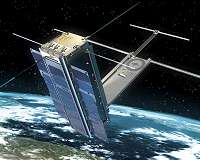
UNSW Canberra has signed a $9.96 million contract with the Royal Australian Air Force (RAAF) to develop new ways to enhance Australia's future Defence space capability.
Engineers and scientists from UNSW Canberra Space will design and build three Cubesat spacecraft for two space missions, to be launched into Low Earth Orbit. The first will lift-off in early 2018, followed by the second in 2019.
Director of UNSW Canberra Space, Professor Russell Boyce says the Cubesats will be used for maritime surveillance.
"These spacecraft are able to gather remote sensing information with radios and cameras, and are the sort of innovative space capability that can help meet many ground-based needs in ways that make sense for Australia," Professor Boyce said.
"Because they have re-programmable software defined radios on board, we can change their purpose on the fly during the mission, which greatly improves the spacecraft's functional capabilities for multiple use by Defence."
The space missions will also deliver research and educational outcomes for Defence and civilian students studying engineering at UNSW Canberra.
UNSW Canberra Rector, Professor Michael Frater says the space program leverages the university's core strengths in satellite and sensor R and D.
"UNSW Canberra has invested significantly to build a very large world-class team of space scientists and engineers. With the announcement this week of a national space agency, we are very excited about the future of space in Australia. We look forward to having a leading role in the space industry, both through education and research."
Leonardo to aid cyber-protection of satellite navigation
Leonardo is to define the requirements and processes for the cyber protection of the Galileo satellite navigation program.
The program is managed by the European Commission. The European Space Agency is responsible for the system's infrastructure.
"Satellite-based assets play a major role in the daily lives of citizens and for national critical infrastructures," said Leonardo Chi … read more
