
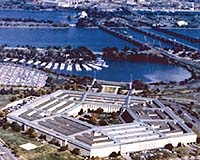
The colossal US defense budget was the first to be cut by President Barack Obama in his 2010 budget, but savings are marginal compared to the 664 billion dollars the US military will soak up next year.
About half the 17 billion dollars in cuts that the White House put in its proposed 3.4 trillion dollar 2010 budget are from defense programs, a senior US official said.
The biggest slice will come from a halt in purchases of the F-22 Raptor fighter jets, a 2.9 billion dollar expense in 2009 that will go away in 2010.
Conceived during the Cold War and built by Lockheed Martin and Boeing, the aircraft has been criticized as unsuited for today's conflicts.
Next in line were reductions in Pentagon sub-contracting services, which would be cut to 19.2 billion dollars in 2010, 900 million dollars less than 2009.
The cancellation of an air force satellite offered another 768 million dollars in savings.
A program for new presidential helicopters, which is six years behind schedule and has sunk costs of 13 billion dollars, will be reduced by 750 million dollars.
The cuts are in line with proposals made by Defense Secretary Robert Gates, who wants to make sweeping changes to the Pentagon's procurement system.
He has pressed the military to give greater priority to weapons needed to fight insurgencies in Iraq and Afghanistan, at the expense of large scale weapons programs designed for conventional warfare between states.
He also has pushed the military services to rein in cost overruns and schedule delays.
But on the astronomical scale of the Pentagon budget, which is by far the biggest of any US department and represents 40 percent of world military spending, the billions of dollars in proposed cuts amount to small change.
The Obama administration seeks a 663.7 billion dollar defense budget, including 130 billion dollars for the wars in Iraq and Afghanistan, where about 180,000 US troops are currently deployed.
On Thursday Pentagon budget documents showed the cost of fighting the war in Afghanistan costing 65 billion dollars next year, overtaking spending in Iraq for the first time.
Operation in Iraq for 2010 are expected to cost 61 billion dollars.
The budget package represents an increase of about two percent over the previous year, a fairly modest gain compared to the four to five percent annual increases in defense spending during the administration of president George W. Bush.
Since 2001, the US defense budget has more than doubled.
"I think that bears out the statement Secretary Gates has made that the spigot of defense spending, which opened wide after 9/11, is starting to close," said Robert Hale, the Pentagon's comptroller.
But the Pentagon recognizes that it is more a question in the short term of rebalancing spending in favor of insurgency warfare than of making drastic changes in its way of life.
"These recommendations are less about budget numbers than they are about how the US military thinks about and prepares for the future," Gates said recently.
"Fundamentally, the proposals are about how we think about the nature of warfare. About how we take care of our people," he said.
But the Defense Department is still counting on the reform of its procurement system and the gradual withdrawal of troops from Iraq to reduce, over time, the pace of its spending.
Share This Article With Planet Earth
