
US-Japan relations have been rattled by a row over an American military base since a centre-left government took power in Tokyo more than six months ago, ending a half-century of conservative reign.
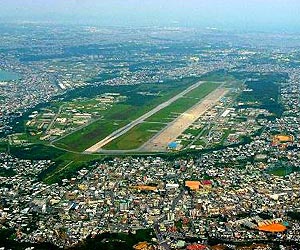
The dispute centres on the controversial US Marine Corps Futenma Air Station on the southern island of Okinawa, where locals have long complained of the heavy US military presence that started with the end of World War II.
The air operations of Futenma, located in the urban area of Ginowan, had been due to be transferred to Nago on the coast by 2014 under a pact struck in 2006, when conservative governments were in power in Washington and Tokyo.
Under the deal, which was a decade in the making, about 8,000 Marines and their dependants were also to be transferred to the US territory of Guam, and the land area of several US military facilities would be returned to Japan.
However, the government of Prime Minister Yukio Hatoyama and his left-leaning allies launched a review of the deal and said the unpopular base may have to be moved off Okinawa or even outside Japan altogether.
The idea has been welcomed in Okinawa, where anger has long simmered over aircraft noise and pollution from US bases, the risk of accidents, and crimes committed by US troops, especially the 1995 gang-rape of a schoolgirl.
Local opponents also say that building the replacement base at Nago near the US Camp Schwab, including new V-shaped offshore runways, would destroy a fragile marine habitat, home to corals and the rare sea mammal the dugong.
The administration of US President Barack Obama has repeatedly urged Tokyo to stick with the original agreement, arguing that its bases on Okinawa are key to ensuring Japan's security and stability in the Asia-Pacific region.
Hatoyama, who has voiced admiration for Obama but also pledged a more assertive Japanese foreign policy, has been criticised for letting the dispute fester for months and has set himself an end-of-May deadline to resolve it.
The presence of US military bases in Japan dates from the end of World War II, when US forces under General Douglas McArthur occupied the country.
The shattered country remained under US occupation until 1952, when it regained its independence under a war-renouncing constitution, and now its former enemy and occupier is Japan's key security ally.
Many US bases in Japan have stirred anger among local residents, among them also the Marine Corps Iwakuni Air Station in Yamaguchi prefecture and Kadena Air Base on Okinawa, the hub for the US air force in East Asia.
Okinawa — which saw some of the bloodiest battles of WWII, and which was not returned to Japan until 1972 — has been the biggest flashpoint because it has by far the heaviest US military presence in Japan.
The island hosts more than half of the 47,000 US forces in Japan. Of the 85 US military facilities in the country, 33 are on Okinawa or tiny neighbouring islands.
In terms of Japanese land provided to US forces, 74 percent is on Okinawa.
Futenma has been a particular focus of complaints, in part because it sits in the middle of a densely populated area where residents have to live with the noise of military aircraft take-offs and landings.
Share This Article With Planet Earth
