
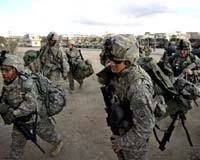
President Barack Obama has deployed 200 more troops to Baghdad to protect the US embassy as Iraq's parliament was set to convene Tuesday to seek a solution to the country's sectarian crisis.
"In light of the security situation in Baghdad, I have ordered up to approximately 200 additional US Armed Forces personnel to Iraq to reinforce security at the US Embassy, its support facilities, and the Baghdad International Airport," Obama said in a letter to Congress released Monday.
"This force is deploying for the purpose of protecting US citizens and property, if necessary, and is equipped for combat."
The latest deployment which the Pentagon said had arrived in Iraq on Sunday brings the number of US troops and embassy security forces to 800, following the sudden advance of the Sunni militants that has left nearly 2,000 people dead this month.
Iraqi forces meanwhile pressed a counter-offensive Monday against executed dictator Saddam Hussein's hometown of Tikrit, one of a string of towns and cities overrun by jihadist-led fighters.
An army officer said troops controlled parts of the outskirts of the city, some 160 kilometres (100 miles) north of Baghdad, which the militants captured on June 11.
The conflict has displaced hundreds of thousands and piled pressure on Prime Minister Nuri al-Maliki.
Maliki's bid for a third term in office has been battered by the offensive and he is no longer seen as the clear frontrunner when the new parliament elected in April holds its opening session on Tuesday.
World leaders and leading clerics have pressed Iraqi leaders to unite and quickly form a government, but despite the urgency, politicians have warned that the process of choosing a new prime minister could take more than a month.
– 'Sense of ambition' –
The Islamic State of Iraq and the Levant renamed itself simply the Islamic State (IS) and declared its shadowy frontman the leader of the world's Muslims, in a clear challenge to Al-Qaeda for control of the global jihadist movement.
IS announced on Sunday that it was establishing a "caliphate" — an Islamic form of government last seen under the Ottoman Empire — extending now from Aleppo in northern Syria to Diyala province in eastern Iraq, the regions where it has fought against the regimes in power.
In an audio recording posted online, the group declared its chief Abu Bakr al-Baghdadi "the caliph" and "leader for Muslims everywhere". Henceforth, the group said, he is to be known as "caliph Ibrahim" — a reference to his real name.
Although the move may not have immediate significant impact on the ground, it is an indicator of the group's confidence and marks a move against Al-Qaeda — from which it broke away, analysts say.
"I don't think this materially changes anything," said Shashank Joshi, research fellow at the Royal United Services Institute think tank in London.
"What it really changes is the sense of their ambition. It's a potentially inspiring and invigorating movement for people worldwide.
"It will tempt many radicalised Muslims to join their cause."
Baghdadi, thought to have been born in the Iraqi city of Samarra in 1971, is touted by the group as a battle-hardened tactician who fought American forces following the US-led invasion of 2003, and is now widely seen as rivalling Al-Qaeda chief Ayman al-Zawahiri as the world's most influential jihadist.
His group has drawn thousands of foreign fighters, attracted by a combination of Baghdadi's own appeal, IS's efforts to establish what it believes is an ideal Islamic state, and the group's sophisticated propaganda apparatus, which publishes magazines and videos in English and a host of European languages.
The group is known for its brutality, summarily executing its opponents and this week crucifying rival Islamist rebels in Syria.
In Syria, IS fighters control large swathes of territory in Deir Ezzor near the Iraq border, Raqa in the north, as well as parts of neighbouring Aleppo province.
– 'No meaning' –
In Iraq, IS has spearheaded a lightning advance since June 9, capturing sizeable territories in the north and west, including the country's second city Mosul.
Washington, however, said the caliphate declaration had "no meaning", with State Department spokeswoman Jen Psaki telling reporters that it just "exposed the true nature of this organisation and its desire to control people by fear".
Iraqi forces initially wilted in the face of the onslaught but have mounted an ambitious counter-offensive to take back Tikrit, a battle which could be crucial tactically and for the morale of the security forces.
They have nevertheless suffered heavy casualties, with 380 soldiers among the nearly 2,000 people who died in June, the highest death toll since May 2007, according to figures released by Iraqi ministries.
In May 2007, Iraq was in the throes of a brutal sectarian war between the Shiite majority and the Sunni Arab minority that claimed tens of thousands of lives.
Football-crazed Iraqis watch World Cup despite danger
Baghdad (AFP) July 01, 2014 –
Raad Abdulhussein sits glued to a television in a Baghdad cafe, anxious over the dual concerns of his team trailing in a World Cup match, and the danger of bombings.
He puffs continually on a waterpipe as he sits quietly with three friends in the "Facebook" cafe, the silence only broken by shouts or clapping when the Netherlands advance toward Mexico's goal.
"Football brings us together," says Raad, a 30-year-old taxi driver, who visits the cafe every day with his friends to watch the matches, which due to the time difference are broadcast in the evening in Iraq.
"It is our only way to leave the atmosphere of worry and tension and fear of the unknown," he says.
"A car may explode at any moment, or a bomb, or a person enters the cafe and blows himself up," Raad says.
This year's World Cup comes during an unprecedented decline in security within Iraq, with Sunni militants led by the Islamic State (IS) jihadist group overrunning parts of five provinces in a lightning offensive that Iraqi soldiers and police are struggling to contain.
While the militant drive has yet to truly threaten Baghdad, the group's spokesman has vowed its forces will push on to the Iraqi capital and Shiite shrine cities farther south.
But the offensive is by no means the first time Baghdad residents have faced threats while going out to watch matches — the capital has lived under constant threat of bombings and violence for years.
Cafes are especially dangerous places, as militants often target them and other places where crowds of people gather, including markets and mosques.
Late last year, Baghdad security officials even held a seminar for cafe owners on how to deter and stop suicide bombers, after nearly 50 cafes were bombed nationwide in barely six months.
– Danger worsened in Ramadan –
That danger is compounded during the current holy Muslim fasting month of Ramadan, when militants sometimes carry out attacks following the meal known as iftar that breaks the daily fast.
But with the World Cup only held every four years, football-crazed Iraqis still take to cafes to watch matches, especially as many suffer lengthy power cuts that prevent them from tuning in at home.
"The atmosphere of the (World Cup) outside the home is better," says Osama Salem, a 31-year-old salesman.
But he adds with disappointment that "we have supported the Netherlands team for years, and the Netherlands are now down a goal."
"The World Cup is organised once every four years — do we sit in our homes and give in to fear?" he continues, while trying to focus on the match, which the Netherlands ultimately won.
"We sit and we are afraid, but what can we do?"
"God willing, this ordeal will end," he says, fatalistically adding that if it is one's time to die, you will die wherever you are.
In sharply-divided Iraq, football is one of the few unifiers. This was especially the case in 2007, when the country cheered on the national side as it won the Asia Cup at the height of a brutal sectarian war in which tens of thousands were killed.
The World Cup "is the most beautiful thing. The whole world is watching it, and the people here are overjoyed by it and come to watch" until late at night, says Ali Hussein, a 21-year-old who works at the Facebook cafe, where patrons must go through strict security measures before they enter.
"Football is life for Iraqis, and we all remember the year 2007, when all the people went out in the street, no Sunni and no Shiite and no Kurds — everyone behind the team."
"If Iraq qualified for the World Cup, maybe it would unite us again."
