
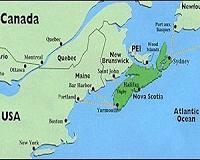
A petroleum board for the province of Nova Scotia aims to bring explorers to frontier territory, touting geological prospects over short-term economics.
The Canada-Nova Scotia Offshore Petroleum Board issued a call for bids for nine frontier prospects as part of an annual bidding round that's just five years old.
Nova Scotia's government estimates there may be as much as 120 trillion cubic feet of natural gas and 8 billion barrels of oil offshore. At least two of the nine parcels up for grabs have proven oil and gas potential, though neither has yet been considered viable for commercial development.
The call for bids comes as energy companies are spending less on exploration and production in a weakened crude oil market. U.S. rig company Hercules Offshore this week said it expected 2015 would be a "very challenging year" for those in the upstream sector as spending dwindles.
Kathleen Funke, a spokeswoman for the petroleum board, said she couldn't speculate on industry interest based on market conditions.
"Parcels are chosen by the board based on geology, not economics," she said in a telephone interview.
All of the parcels up for grabs are located near licenses held by major energy companies like Shell and BP. Last year, the provincial government awarded British energy services company Petrofac with a contract to examine the prospects of oil trapped in the deep waters off the eastern Canadian coast.
Petrofac said the region is geologically similar to oil basins off the northwest coast of Africa, though reserves offshore Nova Scotia are thought to lie nearly 2 miles below the sea bed in mile-deep waters.
Environmental advocacy groups have called for a review of offshore work in frontier territories, saying the seismic surveys needed to get a better understanding of the reserve potential pose a threat to maritime ecosystems. Funke said, however, that regional safeguards are "much higher" than the rest of the world.
A January report from the International Monetary Fund found lower crude oil prices would be a drag on investment activity in Canada, with the energy sector bearing the brunt of market trends. While costs may be higher for Nova Scotian reserves, board Chief Executive Officer Stuart Pinks said the basins up for bidding do have proven potential for oil and gas based on recent geological studies.
"While the oil industry has faced unfavorable economic conditions, our experience is that oil companies are continuing to work toward long-term results, particularly in frontier areas," Funke said.
Bids to the petroleum board must be received by Oct. 29.
