
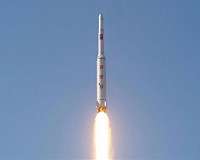
North Korea intends to continue launching satellites, despite UN Security Council sanctions and resolutions. According to the newspaper Rodong Sinmun, the country will continue to launch satellites when and where its leadership determines. On February 7, 2016, North Korea put a satellite into orbit, violating UN Security Council resolutions. The move is considered threatening since the international community believes the North could use its rocket technology to develop ballistic nuclear missiles.
Pyongyang has successfully conducted five nuclear tests, including two in 2016, and has frequently made statements about the advancement of its nuclear program. In January, the North Korean Foreign Ministry announced that the country was ready to launch an intercontinental ballistic missile (ICBM) "anytime and anywhere."
Satellite Data Shows North Korea Tightening Security At Missile Launch Site
North Korea has beefed up security at its Sohae satellite launch station, causing some US analysts to believe that the country is preparing to test ballistic-missile technology currently banned by the United Nations.
An analysis by Joseph Bermudez, a North Korean military affairs expert, published by 38 North, a US-based website monitoring activities in the DPRK, used satellite images to confirm extensions to the station's outer and inner security perimeters.
38 North's summary stated, "While the upgrades are likely tied to the master construction plan, they may also indicate that the launch facility could soon be occupied by NADA and KPA scientists, engineers, technicians and support personnel. Upgraded security may also reflect a growing North Korean concern of intelligence collection by foreign governments using defectors from the area or outside agents to infiltrate and collect information."
Bermudez's report suggested that these extensions began in 2011, and described new guard positions and fences that had been added to areas where before there were only simple patrol paths.
"Today, the outer security perimeter is [about 17 miles] long, encompassing [nearly 11 square miles] and 12 villages," he said, adding, "The inner security perimeter is [about 12 miles] long, encompassing [nearly 6 square miles] and the Sohae launch facility proper."
The UN Security council has decried the DPRK's ballistic missile launches, describing them as "grave violations" of the organization's ban on such activity, and advised member states to pass further sanctions against Pyongyang.
After the DPRK launched a missile from a submarine on August 24, the Japanese Foreign Ministry released a statement criticizing Pyongyang saying, "[The US and Japan] agreed that North Korea's launch of a ballistic missile from a submarine on August 24 is unacceptable, and confirmed their intention to continue to stay in close cooperation on the Issue of North Korea, including at the platform of the UN Security Council."
The European Council tightened sanctions on North Korea in January, after Pyongyang claimed that it had successfully tested a hydrogen bomb. The Council stated, "Considering that the actions of the DPRK constitute a grave threat to international peace and security in the region and beyond, the EU decided to further expand its restrictive measures targeting the DPRK's nuclear, weapons of mass destruction and ballistic missile programmes."
Photos show progress at the Punggye-ri underground nuclear test site where the bomb was said to have been detonated.
Sohae, located in the northwestern territory of Tongchang-ri, was the site of a successful long-range rocket launch in February, in which a satellite was put into orbit. This led to a controversial agreement between the US and South Korea to construct the Terminal High-Altitude Area Defense system (THAAD), as a preemptive step to protecting the peninsula from North Korean aggression.
