
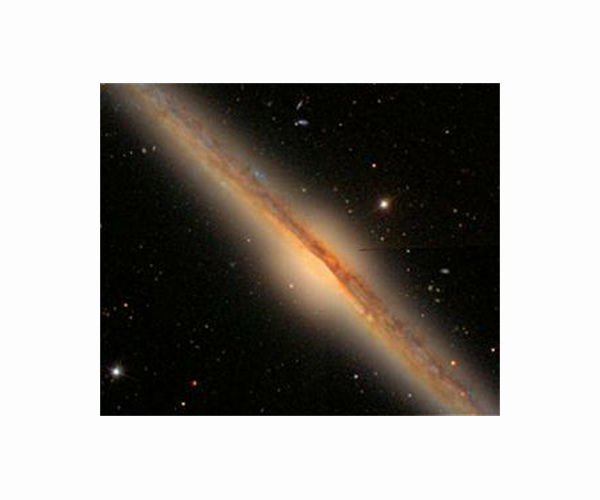
Most spiral galaxies are characterized by a disk, where stars, gas and dust spread out in a characteristic pattern of twisted spiral arms, and a bright central area, named the bulge. When studying how galaxies form and evolve, it is crucial to differentiate between these two components. This represents a scientific challenge and previous studies have traditionally assumed that the disk brightness increases exponentially all the way to the galactic centre.
This common assumption is challenged in a study, published in Astronomy and Astrophysics and authored by Iris Breda, Polychronis Papaderos and Jean Michel Gomes, of Instituto de Astrofisica e Ciencias do Espaco (IA).
Using a new technique to separate the bulge from the disk applied to 135 spiral galaxies from the CALIFA survey, the researchers found a lesser contribution of stars from the disk to the overall brightness of the galaxy centre. According to the authors, this has wide implications for studies on galaxy formation and evolution.
"We developed a new spectrophotometric bulge-disk decomposition technique that for the first time combines advanced spectral synthesis and surface photometry tools, including two developed at IA, the FADO and iFIT tools," says Iris Breda, of IA and Universidade do Porto (U.Porto).
"We used them to determine the maximum contribution of the disk inside the radius of the bulge. This technique, that we applied to a representative sample of spiral galaxies, has revealed that, in approximately one third of them, the disk beneath the bulge does not preserve its exponential profile, but shows instead a central flattening or even a strong decrease."
If confirmed, this discovery implies that the relative amount contributed from disk and bulge stars to the galaxy centre is different than previously presented in a substantial number of studies that assumed an exponential increase up to the centre of the disk. "This may, therefore, have far-reaching implications for our understanding of the structural and dynamical evolution of spiral galaxies," adds Breda.
Previous studies on spiral galaxy evolution may be flawed by assuming that the brightness contribution from stars intrinsic to the bulge is less significant than it actually is. For instance, in spiral galaxies in which the disk represents 80 percent of the luminosity in the central area, its overestimation may lead to an erroneous classification of the type of bulge.
This has even further implications when dealing with galaxies with intense activity in their cores associated with the presence of a supermassive black hole, the so-called Active Galactic Nucleus (AGN).
Polychronis Papaderos, from Faculdade de Ciencias da Universidade de Lisboa (Ciencias ULisboa) and leader of IA's thematic line 'The assembly history of galaxies resolved in space and time' says: "The confirmation of a flattening or even down-bending of the density of the stellar population of the disk within the radius of the galactic bulge would imply an upward revision of mass determinations for galactic bulges.
"This, in turn, will presumably lead to a change in the mass correlation between bulge and supermassive black hole, and place important new constraints on galaxy formation models."
