
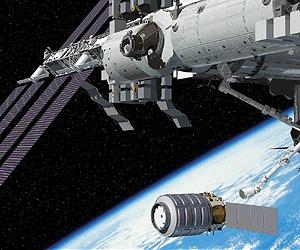
Neptec Design Group, a leader in space, defence and industrial systems and applications, has announced it will provide its TriDAR rendezvous and docking sensors to Orbital Space Science Corp.'s Cygnus Spacecraft capsule, which will be used on the Cargo Resupply Services Program to resupply the International Space Station (ISS).
Fresh off three successful test missions with the Space Shuttle, including the historic final flight STS-135, this partnership will see Neptec supply Orbital with 13 TriDAR systems to support Orbital's initial round of resupply flights for the ISS.
"We are thrilled to be a part of this exciting next step of space exploration," said Mike Kearns, Neptec VP for Space Exploration.
With our operations on STS-135 wrapping up, we are proud to say TriDAR exceeded our expectations on its three separate shuttle flights and we are pleased to announce that the system will be an integral part of the ISS fleet of resupply vehicles."
The TriDAR vision system has been in development for almost 10 years, benefitting from assistance from both the Canadian Space Agency and NASA. A combination of high-precision, near-field triangulation with a long-range Time-of-Flight (LiDAR) system, it provides automated, real-time visual guidance for navigation, rendezvous and docking procedures.
"The TriDAR program is a textbook example of what can be done when government and the private sector work together," said Neptec president and CEO Iain Christie.
"This week is bittersweet for all of us involved with the space program as we wrap up the Shuttle era, which has been a central part of our lives.
"But this announcement shows we are taking our knowledge and experience from that program and continuing to make important contributions to the Space Station and beyond."
The TriDAR vision system provides real-time visual guidance for navigation, rendezvous and docking procedures. Its inaugural voyage into space was in August 2009 when mounted in the cargo bay of the STS-128 mission. Developed by Neptec with the support of NASA and the Canadian Space Agency, TriDAR has applications beyond rendezvous and docking.
With short and long-range sensing capabilities, the system is being developed as a navigation system for lunar rovers, vehicle inspection, and will enable helicopter pilots to land in inhospitable and obscured environments.
