
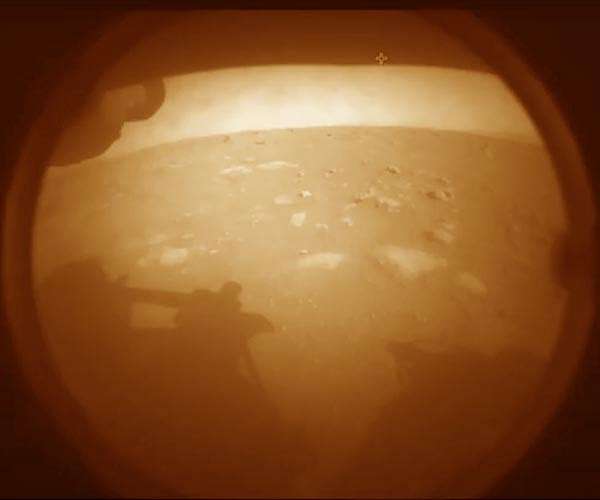
NASA said Thursday that the Perseverance rover has touched down on the surface of Mars after successfully overcoming a risky landing phase known as the "seven minutes of terror."
"Touchdown confirmed," said operations lead Swati Mohan at around 3:55 pm Eastern Time (2055 GMT) as mission control at NASA's Jet Propulsion Laboratory headquarters erupted in cheers.
The autonomously-guided procedure was completed more than 11 minutes earlier, which is how long it takes for radio signals to return to Earth.
"WOW!!" tweeted NASA Associate Administrator Thomas Zurburchen as he posted the Perseverance's first black and white image from the Jezero Crater in Mars' northern hemisphere.
The rover is only the fifth ever to set its wheels down on Mars. The feat was first accomplished in 1997 and all so far have been American.
About the size of an SUV, it weighs a ton, is equipped with a seven foot (two meter) long robotic arm, has 19 cameras, two microphones, and a suite of cutting-edge instruments to assist in its scientific goals.
Perseverance now embarks on a multi-year mission to search for the biosignatures of microbes that might have existed there billions of years ago, when conditions were warmer and wetter than they are today.
Starting from summer, it will attempt to collect 30 rock and soil samples in sealed tubes, to be eventually sent back to Earth sometime in the 2030s for lab analysis.
"The question of whether there's life beyond Earth is one of the most fundamental and essential questions we can ask," said NASA geologist Katie Stack Morgan.
"Our ability to ask this question and develop the scientific investigations and technology to answer it is one of the things that make us as a species so unique."
NASA also wants to run several eye-catching experiments — including attempting the first powered flight on another planet, with a helicopter drone called Ingenuity that will have to achieve lift in an atmosphere that's one percent the density of Earth's.
earlier UPI report
NASA's new Mars rover, Perseverance, traveled through space to the precise location needed to land successfully Thursday at its intended crater on the Red Planet, agency controllers said.
Landing is planned at around 3:55 p.m. EST in Jezero Crater, which is an ancient lakebed the size of California's Lake Tahoe, on the planet's northern hemisphere.
"We are right where we want to be, so we have hit that bullseye," Allen Chen, a NASA lead engineer on the project, said Wednesday during a press briefing from NASA's Jet Propulsion Laboratory in Pasadena, Calif.
"That's pretty incredible considering our last maneuver [a course correction] was back in December," Chen said.
Weather at Jezero Crater appears to be favorable for a landing, Chen said. There are no signs of Mars' dreaded dust storms that can wreak havoc on machinery.
"There are some clouds that are out there … but nothing near our general landing site," Chen said. "The skies look very clear."
At midday Wednesday, the spacecraft was 150,000 miles from the Red Planet, and picking up speed as Mars gravity pulled it closer, said Matt Wallace, deputy project manager for the mission.
The rover's spacecraft is in such good health that "Perseverance could land itself, already, without any more help from us here," Wallace said.
Still, the control room is keeping a close on the interplanetary journey, he said.
"We have to hit an entry corridor that's really just a handful of kilometers across after traveling hundreds of millions of miles to Mars," he said.
"Our batteries are now topped up at 100% state of charge, we have tested out our engines and our guidance sensors. They are ready to go."
Perseverance is NASA's fifth rover mission to Mars. Multiple landers also have explored the planet starting with Viking 1 in 1976.
Perseverance, which was launched from Florida in July, has more science equipment packed on board than any other rover, Wallace said.
Experiments include a helicopter that will fly on another planet for the first time, a chamber to create oxygen from the thin Mars atmosphere and a rock drill that will leave samples on the surface for future missions to collect for a planned return to Earth.
"We have to land safely on Mars, and that is always a challenging feat for us," Wallace said. "It is one of the most difficult maneuvers that we do in space. … You know, almost 50% of the spacecraft that had been sent to the surface of Mars failed."
