
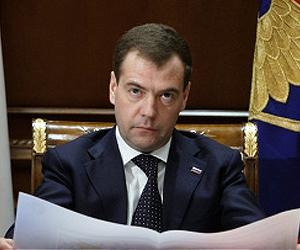
Russian President Dmitry Medvedev arrived here Tuesday for a two-day visit, expected to focus on energy cooperation, including a plan to build Turkey's first nuclear power plant.
Flying in from Syria, Medvedev was to meet Wednesday with Turkish President Abdullah Gul and co-chair with Prime Minister Recep Tayyip Erdogan the first meeting of a recently agreed "high-level cooperation council" comprising several ministers from each side.
The two countries are expected to sign more than 20 agreements, including energy deals, the Kremlin's top foreign policy adviser Sergei Prikhodko said Monday.
Among them is expected to be a memorandum to build and operate a nuclear power station in Turkey.
Russia has long looked to build the country's first nuclear power plant, but a Turkish court last year scrapped a tender won by a Russian-led consortium.
The consortium, led by Russia's state nuclear giant Atomstroiexport, had been the only bidder in the tender to build four nuclear reactors with a total capacity of 4,800-megawatts at Akkuyu, at the Mediterranean coast.
Agreements involving gas giant Gazprom and state oil firm Rosneft will be among the "most commercially significant" deals to be inked in Ankara Wednesday, Prikhodko said.
Russia is Turkey's main gas supplier and wants to build a section of its key South Stream pipeline through Turkey's Black Sea waters in a new route for Russian gas to Europe bypassing Ukraine.
Turkey, which backs also the European Union's rival Nabucco pipeline, agreed in August to allow Russian surveys for the project in its portion of the Black Sea.
Russia, for its part, promised to support a planned Turkish oil pipeline from the Black Sea port of Samsun to Ceyhan on the Mediterranean, which already serves as a terminal for conduits from Azerbaijan and Iraq.
The protocol involved also plans to extend an existing gas pipeline between the two countries southwards to Lebanon, Syria, Israel and Cyprus.
Writing in an article for the Turkish daily Zaman, Medvedev praised intensifying ties with Turkey, a NATO member.
"We can confidently say that Russian-Turkish ties are approaching the level of a full-fledged strategic partnership," he said in comments released for publication Monday.
Despite sometimes shaky political ties, economic exchange between the two countries has boomed since the fall of Communism: in 2009, their trade volume stood at 22.9 billion dollars, making Russia one of Turkey's top commercial partners.
Russia's military intervention in Georgia in 2008 briefly strained relations with Turkey, which has close economic and political ties with the former Soviet republic, its northeastern neighbour.
Russia supplies about 60 percent of Turkey's gas imports, and more than a million Russian holiday-makers boost Turkey's vital tourism sector each year.
Share This Article With Planet Earth
