
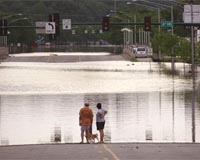
Fifteen buildings lost to floodwaters doesn't sound like much.
But in Columbus Junction, Iowa it meant there is no more gas station, no more firehouse, no more water treatment plant, grocery store, daycare, doctor's office, dentist, bowling alley, senior's center, pharmacy, hotel or veterinarian.
Even the new medical clinic for the town's low-income residents – which had a grand opening set for Thursday – was lost.
"The closest doctor is going to be 25 miles away and a lot of the people living here don't have vehicles," city council member Hal Prior said.
And some of those who can drive out of town for their necessities face psychological barriers, he said.
"This is a rural farm community," he told AFP. "There are a lot of people here who've never ventured more than 25 miles away."
The town of less than 2,000 is about a half a mile downstream from where the Cedar Rapids and Iowa Rivers meet.
They'd seen how the floodwaters had ravaged towns upstream – 1,300 blocks of Cedar Rapids were inundated and Iowa City was saved only by its steep hills – and knew it was going to be bad.
They just hoped it wouldn't be this bad.
Sandbagging started on Tuesday to build a temporary dike to give added protection to those two key streets. Then more rain fell and they decided to raise the height of the levee and build secondary dikes.
An 83-year-old woman and a man in his sixties who'd had a heart transplant a few years back were among the volunteers.
People brought their own shovels. One woman wouldn't quit filling bags with sand until her hands were rubbed so raw they started bleeding.
On Saturday the National Guard troops who had been helping them were redeployed. The water was coming too fast and too high.
The mayor broke into tears when he told the townsfolk they had to give up.
The breach was not as dramatic as Prior expected. A 100-foot long portion of the dike slowly crumbled and then the water seeped across the low-lying ground.
"It was kind of like the tide coming in from the ocean," Prior said.
A couple breaches downriver eased pressure Sunday morning and the water had receded about six inches by dinner time. But there was still about ten or twelve feet in the senior's center, where only the new roof was visible.
"It makes me cry," Rolene Fuller, 64, said as she stood on a hill overlooking the damage.
Fuller lost her job when the daycare center flooded. It's government funded, so she knows it will reopen. But the owner of the bowling alley – who only bought it six months ago – has said he can't afford to rebuild.
While that will devastate her husband – he goes through withdrawal every spring when his league season ends – Fuller's biggest concern is that the low-income immigrant families who work at the town's meat packing plant will leave rather than wait for key services to come back.
"It's heartbreaking," she said. "It's my home and it's going to change it so much that we won't even know for months."
