
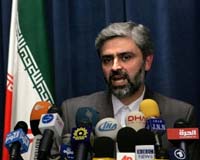
Iran said on Sunday its nuclear standoff with the West will be strictly off the agenda when Iranian officials hold rare talks this month with US diplomats in Baghdad over Iraq. "We do not want there to be any connection between the nuclear talks and the discussions on Iraq," foreign ministry spokesman Mohammad Ali Hosseini told reporters.
"If there is someone who wants to connect the nuclear issue with Iraq then this is something that we do not want," he added.
US and Iranian envoys are to meet in Baghdad on May 28 for talks on Iraqi security, three days ahead of the latest encounter between Iran's nuclear negotiator Ali Larijani and EU foreign policy chief Javier Solana to break the deadlock in the nuclear crisis.
Iran's leaders have repeatedly said they are ready for full negotiations with the United States, but only if Washington changes its position towards the Islamic republic which it accuses of sponsoring terrorism.
"As we have said, we will not have negotiations with the United States unless they rectify their position," said Hosseini.
He declined to say whether the May 28 meeting on Iraq would be followed by other encounters. "Let the first session convene, do not make speculation and we will see what happens."
Iran's supreme leader Ayatollah Ali Khamenei said last week that Iran would use the talks with US diplomats over Iraq to remind Washington of its "occupiers' duty" in the conflict-torn country.
A top Iranian national security official said on Sunday that Iran would be asking Washington for a clear timetable for a full handover of security power to the Iraqi government and a pullout of US troops.
"During these talks we will ask the United States to impose security in Iraq and restore power to the Iraqi authorities in line with a clear calendar," said deputy head of the national security council Abdolreza Rahmani Fazli.
"We will also ask the Americans to give a date for the pullout of their troops," he added, according to the ISNA agency.
The United States accuses Iran of seeking nuclear weapons and wants Tehran to freeze sensitive uranium enrichment operations immediately. Iran says its atomic drive is peaceful and that it has every right to the full fuel cycle.
US-Iran relations have been frozen since 1980 after radical students stormed the American embassy in Tehran in the wake of the country's Islamic revolution and held its diplomats hostage for 444 days.
earlier related report
Swiss diplomacy over Iran nuclear programme is 'farce': Bolton
Geneva (AFP) May 20 – Swiss diplomatic moves to resolve the dispute over Iran's nuclear programme by compromises on both sides are a "farce" and should be withdrawn, former US ambassador to the United Nations John Bolton said on Sunday.
The so-called "Swiss Paper" proposes that Iran freeze its work on sensitive nuclear activities while world powers halt UN sanctions action, in the hope that this mutual pause will create room for manoeuvre.
Bolton, who was a leading hawk in the Bush administration in the run-up to the invasion of Iraq, told Swiss newspaper SonntagsZeitung that the plan is a "farce".
"Switzerland should keep out of it," he added.
Bolton stepped down as ambassador to the UN last December, after it became clear the new Democrat-led Congress would not confirm his appointment.
He now works for the American Enterprise Institute, a leading conservative think tank in Washington.
Iran earlier this month also rejected the proposals as unacceptable.
"We believe it is a kind of suspension to which we have given a negative response and will not accept," said Abdolreza Rahmani Fazli, the deputy secretary of Iran's Supreme National Security Council.
The United States accuses Iran of using its nuclear programme to secretly develop an atomic bomb. Tehran denies the charge and insists its nuclear activities are for peaceful purposes.
Enrichment is hugely sensitive because the process can be used to make the core of an atom bomb as well as nuclear fuel.
Source: Agence France-Presse
