
India said Thursday it would begin crucial contract negotiations in the next fortnight for an estimated $12 billion order for 126 fighter jets.
The announcement came a day after Indian Defence Minister A.K. Antony said the long-delayed contract to modernise India's decades-old aircraft fleet would be handed out during the next fiscal year starting April 1.
"The contract negotiation committee will begin discussions in a week or two," Indian Airforce chief P.V. Naik told reporters on the sidelines of South Asia's biggest airshow in Bangalore, the hub of India's aviation industry.
Six global aeronautical companies, which are in a dogfight to grab the deal to sell the 126 Medium Multi-Role Combat Aircraft (MMRCA), each claimed at the airshow that their products were the world's best.
"The Indian airforce is very pleased with the performance of the F-16 and we are hopeful of being shortlisted," said Orville Prins of U.S-based Lockheed Martin which wants to sell its frontline fighter jet to India.
India, the biggest buyer of military hardware among emerging nations, issued the request for proposals to the six firms in 2007 and the long-awaited trials of the aircraft competing for the deal began a year later.
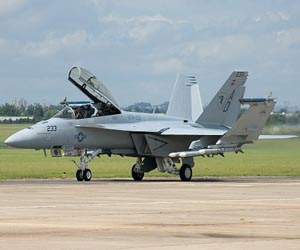
Industry sources say the F-16 and Seattle-based Boeing, which is offering its F-18 "Superhornet," have emerged as front-runners after the gruelling trials.
The contract includes the outright purchase of 18 combat aircraft by 2012 with another 108 to be built in India. India would also have an option to buy 64 more such jets.
The other companies bidding include France's Dassault Aviation, pan-European manufacturer Eurofighter Typhoon and Sweden's Saab.
Saab will have the "technological lead in five years," said Peter Nilsson, an executive from the Swedish firm.
India also announced Thursday it is set to agree a contract with Dassault for the upgrade of its fleet of Mirage fighter aircraft but would not disclose the value of the deal.
Russia, a longtime military supplier to India, pipped its Western rivals last December when it signed a mammoth agreement with New Delhi to co-produce some 250 stealth fighter jets worth $30 billion by 2017.
earlier related report
U.K. on shortlist of Brazil arms suppliers
Rio De Janeiro (UPI) Feb 7, 2011 -Britain is on the shortlist of potential contractors for huge military purchases planned by Brazil to modernize its armed forces and build a defense network for offshore hydrocarbon resources more than 120 miles from the country's vast coastline.
Brazil's 4,644-mile-long front to the Atlantic is the world's 16th longest national coastline and the discovery of oil and natural gas offshore has made maritime border protection an urgent new priority on a grand scale for the government.
Two years ago Brazil began an arms shopping spree, setting targets to invest more than $12 billion in land and water defenses.
A final decision on fighter aircraft and helicopters was postponed before President Dilma Rousseff took office in January. Former President Luiz Inacio Lula da Silva, who signed initial agreements with France for the supply of jets and helicopters and wide-ranging defense technology transfers, retreated from what appeared at that time to be a deal favoring France. Now a potential deal for the air defenses inventory has gone back under a government review.
The air force deal is still in the balance but latest media reports suggested BAE Systems was well advanced in negotiations to supply advanced naval craft for an expanded maritime defense force planned in response to huge discoveries of offshore gas and oil, MercoPress reported.
Industry analysts said the BAE Systems' appearance on the shortlist, which includes Boeing, France's Dassault and Sweden's Saab, made Brazil one of the fastest growing defense markets.
Brazil and Britain are in negotiation for the purchase of at least six patrol vessels and six Type 26 frigates similar to those deployed by the British navy. The total initial deal could be worth about $5 billion but BAE Systems also pinned hopes on long-term delivery and maintenance contracts.
Work on developing hydrocarbon deposits deep under the seabed, requiring specialized giant drilling platforms and related services, has heightened Brazil's sense of vulnerability in an exposed environment away from the shore.
BAE Systems is also coming round to Brazil's insistence on technology transfer and may offer, as part of the deal, second-phase manufacturing or assembly of a part of the order for naval vessels after first-phase manufacture and assembly in Britain or BAE units elsewhere.
Brazil says its long-term plan is to keep raising defense spending from the current 1.5 percent of its gross domestic product to 2 percent by 2030. The prospect for defense manufacturers is a lucrative one, industry analysts said, because Brazil's nominal GDP in 2010 was estimated to be $2.181 trillion. That makes yearly defense spending estimates ahead of $35 billion or more.
"Brazil has some very serious aspirations and they have the wherewithal to afford them," Ben Palmer, development director for BAE Systems surface ships division, told the Financial Times last year. "There is an awful lot to fight for and a lot of competition."
France is in the race to supply Brazil with naval craft as well as Dassault's Rafale fighter aircraft.
Share This Article With Planet Earth
