
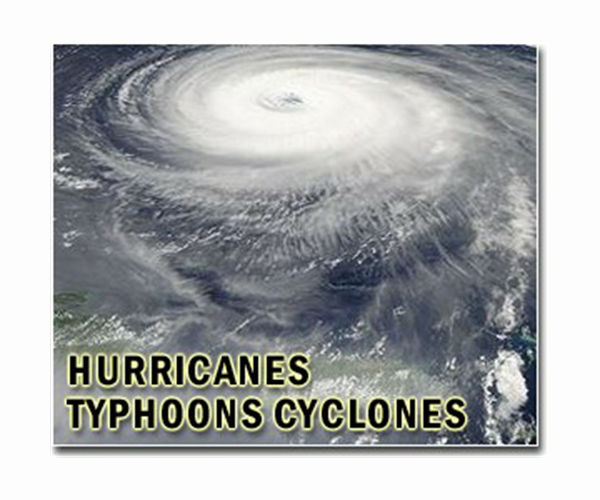
This year's hurricane season has seen a record 29 named tropical storms wreak havoc across the southeastern United States, the Caribbean and Central America, experts said on Tuesday.
The cyclonic storms, which are given named status in the Atlantic when their wind speeds exceed 62 kilometres per hour (39 miles per hour), have already displaced thousands and caused close to $20 billion of damage.
The US National Hurricane Center tweeted that tropical storm Theta had become the 29th event to be named this season, beating the previous record of 28 in 2005 — the year Hurricane Katrina devastated New Orleans.
The NHC was even forced to switch to the Greek alphabet after 2020's storms exhausted its list of Latin names.
Later Tuesday the NHC said there was a 70 percent change that the 30th named storm of the season would form within the next five days.
Experts said climate change was helping to increase ocean temperatures, rendering the cyclones more powerful.
They said 2020's increase in named storms could also be connected to a regional reduction in air pollution over the central Atlantic since the 1980s, as well as the La Nina weather cycle.
"As we continue to warm the planet at the tropical Atlantic, there is more energy to fuel more and stronger tropical storms and hurricanes," said Michael Mann, director of the Earth System Science Center at Pennsylvania State University.
"When we happen to get a La Nina event, as with this year, it reinforces the impact that climate change is having and we get the sorts of devastating storm seasons we are witnessing."
Globally, as ocean temperatures increase in step with climate change, there has been a clear pattern of increasing tropical storm intensity in recent decades.
A study published in June found that the proportion of the strongest storms is increasing about 8 percent a decade, on average.
Hurricane Eta, which slammed into Central America this month, causing at least 130 deaths, is among the strongest November hurricanes ever recorded.
A growing number of tropical cyclones are also forming under a process known as rapid intensification.
This is where storms develop extremely quickly because of warmer waters, which in turn is made more likely as ocean temperatures rise globally.
Nine of 2020's tropical storms have experienced rapid intensification, which makes them harder to forecast and to prepare for landfall.
Eta death toll rises to 57 in hard-hit Honduras
Tegucigalpa (AFP) Nov 10, 2020 –
Fifty-seven people have died and eight are missing in Honduras following Tropical Storm Eta, authorities said Monday, as the death toll doubled in one of the countries worst hit by the storm.
Eta slammed into Central America last week as a Category 4 hurricane, leaving over 200 people across the region dead or missing.
Honduras was one of the worst affected, with swathes of the country now under water and authorities having reported 23 dead on Sunday.
Two major rivers overflowed in Honduras' Sula Valley economic heartland, causing widespread flooding and trapping tens of thousands of people.
Eight people remain missing, according to the country's emergency authority COPECO.
President Juan Orlando Hernandez thanked US soldiers from a joint task force based in Palmerola in the center of the country, as well as neighboring El Salvador, for their help in assisting the victims.
A 21-strong rescue team from El Salvador arrived on Saturday as part of the relief operation.
A convoy of around 60 additional vehicles arrived from the country on Monday, carrying food and other supplies to help hurricane victims and teams of rescue workers and doctors.
Eta left a trail of destruction through Honduras and Guatemala, eventually weakening to a tropical storm after making landfall in Nicaragua on Tuesday.
El Salvador, Costa Rica, Panama, Cuba and Mexico have suffered varying degrees of damage from the storm, which swept into Florida on Monday with strong winds and heavy rain.
The country with the highest death toll so far is Guatemala, where around 150 people are dead or missing.
Torrential rain and a bitter cold front linked to the storm have also claimed at least 20 lives in the southern Mexican state of Chiapas.
