
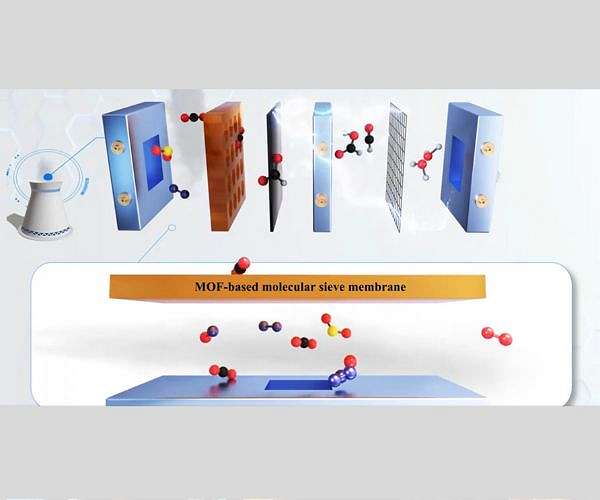
A research team led by Professor Xiao-Ming Chen and Professor Pei-Qin Liao at Sun Yat-Sen University has developed an electrolyzer that integrates a metal-organic framework (MOF) membrane. This device filters and concentrates carbon dioxide (CO2) from dilute sources, such as flue gas and ambient air, and converts it directly into formic acid (HCOOH) without first purifying the CO2 stream.
The MOF membrane performs two roles by selectively removing impurities like sulfur dioxide (SO2), nitrogen oxides (NO), and oxygen (O2), while simultaneously raising the CO2 concentration. When applied to flue gas containing approximately 15 percent CO2, the membrane increased the concentration to 82.5 percent. The integrated electrolyzer then achieved nearly 100 percent Faradaic efficiency in converting the enriched CO2 to formic acid, with a current of 9000 mA, producing 23 mL of anhydrous, electrolyte-free product after four hours. This marks the first time commercial-grade formic acid has been obtained directly from flue gas by electrochemical reduction.
For ambient air containing just 0.04 percent CO2, a KAUST-7-based MOF membrane was used to enrich the CO2 to 2.05 percent. The electrolyzer delivered a Faradaic efficiency of 98.2 percent for formic acid synthesis and a yield rate 5000 times higher than previous catalysts without the membrane. Such performance suggests potential for confined environments, like submarines or space stations, where precise CO2 control is essential.
The research team's techno-economic analysis indicates that using flue gas instead of pure CO2 reduces production costs by 15 percent, eliminating the need for energy-intensive purification. The membrane's selective filtering prevents side reactions with impurities, ensuring stable, high-quality output. This approach advances CO2-to-chemical conversion toward scalable, industrial use by providing a straightforward, cost-effective pathway to transform waste CO2 into valuable products for carbon neutrality.
