
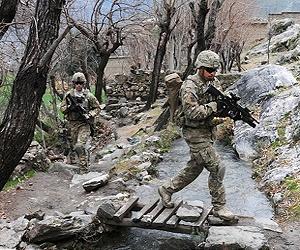
A suicide bombing at the Afghan army headquarters in the country's east killed four people and wounded eight on Saturday, officials told AFP, in an attack claimed by the Taliban.
"Four dead bodies and eight wounded were brought to our hospital," said Baz Mohammad Shairzad, head of the provincial hospital.
A Taliban spokesman, Zabihullah Mujahid, claimed responsibility for the attack in a telephone call to AFP.
The attacker detonated his explosives at the base in the Gambiri area near Jalalabad city, the capital of eastern Nangarhar province, said Mohammad Nooman Hatifi, the Afghan army spokesman for eastern Afghanistan.
A spokesman for the International Security Assistance Force (ISAF), Major Tim James, said there had been "a number of both Afghan and ISAF casualties" in the attack but could not yet give further details.
He added that there were over 100 ISAF troops at the base in Laghman province, primarily tasked with mentoring the Afghan army.
The defence ministry in Kabul confirmed there had been a suicide attack at the base but did not give further details. The area has now been cordoned off.
The blast came a day after the provincial police chief of Kandahar in southern Afghanistan, Khan Mohammad Mujahid, was killed in a suicide bombing claimed by the Taliban which also killed his two bodyguards.
There has been a recent spike in suicide bombings — a key Taliban tactic — in Afghanistan, with authorities reporting nine in the last few days.
About 130,000 international troops are stationed in Afghanistan, two-thirds of them from the United States, battling the Taliban and other insurgents.
Limited withdrawals from seven relatively peaceful areas of the country are due to start in July ahead of the planned end of foreign combat operations in 2014.
Afghan security forces are due to take increasing responsibility for their own country's security as foreign troops pull back.
They are frequently the target of attacks by the Taliban, who have been fighting an insurgency since 2001 when a US-led invasion ousted them from power.
US Secretary of State Hillary Clinton warned at a NATO foreign ministers' meeting in Berlin on Thursday that nations involved in Afghanistan should not rush to exit due to "political expediency and short-term thinking".
"We have to steel ourselves and our publics for the possibility that the Taliban will resort to the most destructive and sensational attacks we have seen," she said.
earlier related report
Deadliest days for NATO in Afghan campaign
Kabul (AFP) April 17, 2011 –
Eight NATO soldiers were killed in Afghanistan on Saturday, the deadliest day for the coalition since June last year.
After a bloody 2010, in which 711 foreign troops died, at least 128 have been killed so far this year, according to the independent icasualties.org website.
Following is a list of some of the deadliest days for NATO since the US-invasion of Afghanistan in 2001 ousted the Taliban:
2005
June 28: Sixteen US soldiers are killed after a rocket fired by Taliban insurgents in the eastern province of Kunar hits a Chinook transport helicopter.
2007
April 8: Six Canadian soldiers with the NATO-led International Security Assistance Force (ISAF) are killed in southern Afghanistan when their vehicle is hit by a roadside bomb.
May 31: Seven soldiers, including five Americans, die when their transport helicopter is hit by a rocket in the southern province of Helmand.
July 4: Six Canadian soldiers and their Afghan interpreter are killed when their armoured vehicle is blown up by a roadside bomb in the south.
November 10: A firefight with Taliban insurgents in the northeast leaves six NATO and two Afghan soldiers dead.
2008
July 13: Nine American soldiers are killed in fierce fighting in Kunar province.
August 18: Ten French soldiers are killed in a Taliban ambush in the Uzbin valley east of Kabul.
2009
September 17: Six Italian soldiers die in a Kabul bomb attack.
October 3: Eight American soldiers are killed in combat in the eastern province of Nuristan, which borders Pakistan.
October 26: A total of 14 Americans are killed in two helicopter crashes.
October 27: Eight American soldiers die in a series of bombings in the south.
December 30: Seven Americans working for the CIA and a Jordanian intelligence agent are killed by an Al-Qaeda suicide attack on an American base in Khost province.
2010
January 11: Six NATO soldiers — three Americans, two French and a Briton — are killed in combat.
May 18: Six NATO soldiers die in a Taliban suicide attack on a convoy in Kabul. Two other soldiers are killed on the day, with four dead the day before.
June 7: Bombings in the south and east kill 10 seven American soldiers, two Australians and one French.
June 22: Ten NATO troops, mostly Americans, die in separate incidents across the country.
July 13-14: Twelve Americans die in a series of rebel attacks in the south.
August 30: Seven US troops die in two Taliban-style bomb attacks in southern Afghanistan.
September 21: Nine ISAF troops are killed in a helicopter crash in southern Afghanistan, with another two ISAF soldiers, an Afghan soldier and a US civilian injured.
October 13: Six NATO soldiers are killed, five in bomb attacks and one fighting insurgents.
October 14: Eight NATO soldiers, including a Pole, are killed in bomb attacks in different parts of the country.
November 5: Six NATO soldiers are killed in two days of fighting with the Taliban in the east and south of Afghanistan.
November 14: In one weekend, 10 NATO troops are killed — including seven in a single day — in blasts and an insurgent attack.
December 12: An insurgent attack in the south kills six NATO soldiers.
2011
January 12: Five NATO soldiers killed in the south and east of the country, including three in bomb attacks.
April 16: Suicide attack kills five NATO soldiers in eastern Afghanistan and a bomb attack kills three more in the south.
Share This Article With Planet Earth
