
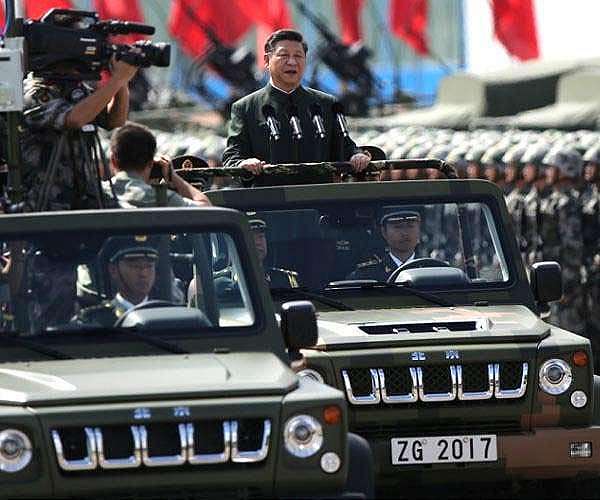
Beijing on Monday said it was ready to defend its national interests over Taiwan, in a rebuke to US President Joe Biden's vow to protect the island from any invasion by China.
China's Communist Party has never controlled self-ruled Taiwan but it views the island as part of its territory and has vowed to one day seize it, by force if needed.
Biden, who is in Tokyo to meet regional allies, earlier on Monday warned that China's increasingly assertive stance over the island was "flirting with danger" and promised to defend Taiwan from any military action by its giant neighbour.
The comments were met with defiance in Beijing, with foreign ministry spokesman Wang Wenbin telling reporters "Taiwan is an inalienable part of China's territory".
"The Taiwan issue is a purely internal affair for China," he said.
"On issues touching on China's core interests of sovereignty and territorial integrity, China has no room for compromise or concession."
Biden made a connection between the response of Western nations to Russia's assault on Ukraine and Beijing's perception of the risks of military action against Taiwan.
But Wang said China would always defend its interests with the force of its 1.4 billion population.
"No one should underestimate the firm resolve, staunch will and strong ability of the Chinese people in defending national sovereignty and territorial integrity," he added.
Biden vows military defence of Taiwan if China invades
Tokyo (AFP) May 23, 2022 – President Joe Biden vowed Monday that US forces would defend Taiwan militarily if China attempted to take control of the self-ruled island by force, warning Beijing was already "flirting with danger".
The remarks, made in Tokyo where he is meeting with Japan's prime minister ahead of a regional summit Tuesday, were Biden's strongest to date on the issue and come amid rising tensions over China's growing economic and military power.
Washington and allies like Japan have framed their tough response to Russia's invasion of Ukraine as a warning to others, especially China, against unilateral military action.
Biden hammered that message home after talks with Japanese Prime Minister Fumio Kishida in which the pair agreed to monitor Chinese naval activity and joint Chinese-Russia exercises.
Biden then went further. Asked if Washington was willing to get involved militarily to defend Taiwan, he replied: "Yes."
"That's the commitment we made," he added.
"We agreed with the One China policy, we signed on to it… but the idea that it can be taken by force is just not appropriate, it would dislocate the entire region and would be another action similar to Ukraine," Biden said.
Biden directly linked the fates of Ukraine and Taiwan, saying Western sanctions on Russia must exact a "long-term price" because otherwise "what signal does that send to China about the cost of attempting to take Taiwan by force?"
He warned Beijing was already "flirting with danger right now by flying so close and all the manoeuvres undertaken" — referring to a growing number of Chinese sorties, naval exercises and other power projection in the Taiwan Straits.
In Beijing, foreign ministry spokesman Wang Wenbin swiftly responded, declaring that "no one should underestimate the firm resolve, staunch will and strong ability of the Chinese people in defending national sovereignty and territorial integrity."
"China has no room for compromise or concession," the spokesman said.
– 'Policy has not changed' –
Like most nations, the United States diplomatically recognises Beijing over Taiwan. But it also maintains de facto diplomatic ties with the self-ruled, democratic island.
For decades it has maintained a policy of "strategic ambiguity" in which it never makes clear what it would do in the event of an invasion while agreeing to help Taiwan build its defenses against attack from Beijing.
The policy was designed both to keep Beijing from declaring war and also to stop Taiwan from formally declaring independence.
Biden's remarks Monday overshadowed his rollout of a new, 13-nation regional trade framework as well as Tuesday's meeting of the Quad group.
The White House said that Biden was not diverging from the official "One China" policy, which includes the commitment to "provide Taiwan with the military means to defend itself".
"Our policy has not changed," the official said.
But Beijing's growing sabre-rattling on the issue, as well as Russia's Ukraine invasion, is clearly shaking up the status quo.
Among those augmenting diplomatic support for Taipei is Japan, which has regularly warned China against "unilateral" attempts to change the impasse.
Kishida called for stability in the Taiwan Strait and said Tokyo was committed to boosting its defence spending, a sensitive subject in a country with constitutional limits on its military.
"Japan will fundamentally strengthen its defence capacity, and to back that up will significantly increase its defence spending," Kishida said at a joint press conference with Biden.
"We don't rule out any options, including (acquiring) the capacity to counter-attack," he added.
– Asia trade grouping launched –
Biden is in Japan on the second leg of an Asia trip intended to reinforce regional ties and show Washington remains committed to the region despite its heavy involvement with the crisis in Ukraine.
He announced Monday that 13 countries have joined a new, US-led Asia-Pacific trade initiative touted as a counterweight to China's aggressive expansion.
On Tuesday, Biden meets with fellow Quad leaders from Japan, Australia and India.
He arrived in Tokyo on Sunday after stopping in Seoul for talks with newly elected President Yoon Suk-yeol.
While there, Biden said he was willing to meet Kim Jong Un if the leader-for-life is "sincere", despite the threat of a possible North Korean nuclear test hanging over the Asian tour.
