
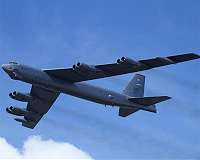
The Chinese defence ministry on Thursday denounced flyovers by US B-52 bombers over the South China Sea and East China Sea as "provocative" actions amid soaring tensions between the two global powers.
The Pentagon said Wednesday the heavy bombers had taken part in a combined operation with Japan over the East China Sea and had flown through international airspace over the South China Sea a day before.
"Regarding the provocative actions of US military aircraft in the South China Sea, we are always resolutely opposed to them, and will continue to take necessary measures in order to strongly handle (this issue)," Chinese defence ministry spokesman Ren Guoqiang told a monthly news briefing.
China has claimed large swaths of the strategic waterway and built up a series of islands and maritime features, turning them into military facilities.
Brunei, Malaysia, the Philippines, Taiwan and Vietnam have competing claims to the region, and an international maritime tribunal ruled in 2016 that China's claims have no legal basis.
Pentagon spokesman Lieutenant Colonel Dave Eastburn said this week's flights were part of "regularly scheduled operations."
The United States rejects China's territorial claims and routinely says the military will "continue to fly, sail and operate wherever international law allows at times and places of our choosing."
Washington this week enacted new tariffs against China covering another $200 billion of its imports while it last week sanctioned a Chinese military organisation for buying Russian weapons.
China has reacted angrily, and this week scrapped a US warship's planned port visit to Hong Kong and cancelled a meeting between the head of the Chinese navy and his American counterpart.
US Defense Secretary Jim Mattis said he was not concerned the US transit flights would increase tensions with China.
"If it was 20 years ago and they have not militarised those features there, it would have just been another bomber on its way to Diego Garcia or whatever," he told Pentagon reporters, referring to the US military base in the Indian Ocean.
"So there's nothing out of the ordinary about it, nor about our ships sailing through there."
The Pentagon chief went on to say there is no "fundamental shift in anything."
"We're just going through one of those periodic points where we've got to learn to manage our differences," he said.
US warship sails near South China Sea area claimed by Beijing: Pentagon
Washington (AFP) Sept 30, 2018 –
An American warship has sailed through waters off the contested Spratly Islands in the South China Sea, in the latest implicit challenge to Beijing's sweeping territorial claims in the region, the Pentagon said Sunday.
"Guided-missile destroyer USS Decatur conducted a freedom of navigation operation," an official told AFP. "Decatur sailed within 12 nautical miles of Gaven and Johnson reefs in the Spratly Islands."
The official said all US military operations in the area "are designed in accordance with international law and demonstrate that the United States will fly, sail and operate wherever international law allows."
The 12-mile distance is commonly accepted as constituting the territorial waters of a landmass. Beijing claims all of the Spratly chain.
There was no immediate reaction from China, but a similar US operation in July, involving the disputed Paracel islands, prompted a furious Beijing to deploy military vessels and fighter jets.
The Paracels, north of the Spratly Islands, are claimed by China, Taiwan and Vietnam.
On May 25, the guided-missile destroyer USS Dewey sailed less than 12 nautical miles from a reef in the Spratly archipelago.
China claims nearly all of the South China Sea, though Taiwan, the Philippines, Brunei, Malaysia and Vietnam all claim parts of it.
Further angering those countries, and the US, Beijing has moved aggressively to build reefs into artificial islands capable of hosting military planes.
US-Chinese relations have been strained on multiple levels since Donald Trump became president in 2017. A trade war launched by Trump has infuriated Beijing, as did his authorization of a $1.3 billion arms sale to Taiwan, which China considers a rebel province.
