
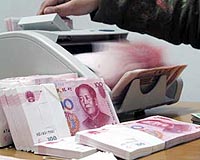
China on Monday launched the sale of six billion yuan (879 million dollars) in government bonds in Hong Kong, the finance ministry said, marking the first such offer outside the mainland.
The sale is another step in efforts by China, which has questioned the US dollar's status as the global reserve currency, to promote international use of the yuan.
"Hong Kong has the conditions and confidence to coordinate with the central government's financial policies and help the yuan to 'go abroad' in a stable and orderly manner," Henry Tang, Hong Kong's chief secretary for administration, said in a statement from China's finance ministry.
Individual and institutional investors can subscribe for two-year and three-year bonds, which carry coupon rates of 2.25 percent and 2.7 percent respectively, the statement said.
Only institutional investors will be allowed to subscribe for five-year bonds, which carry a coupon rate of 3.3 percent.
It said bonds of two-year maturity would mainly target individual investors and those of five-year maturity institutional investors.
Three-year maturity bonds would sell to both investors "depending on the situation then".
The sale is also aimed at boosting Hong Kong's bond market.
"It's a positive step to developing Hong Kong's bond market at the same time as promoting China's yuan internationalisation," said Ben Simpfendorfer, a Hong Kong-based economist at Royal Bank of Scotland.
"I think there will be strong demand given the demographic of Hong Kong is aging and there is a lot of interest in fixed return products that are fairly straight forward."
At least two billion yuan worth of bonds will be available for retail sales, the finance ministry said earlier this month.
Nineteen banks including Bank of China (Hong Kong), HSBC and Bank of East Asia will be selling the bonds to individual investors.
The subscription period starts Monday and ends October 20, with the results to be announced two days later, the statement said. The bonds will be issued on October 27.
China has been pushing aggressively for the wider use of the yuan abroad, signing a series of bilateral currency swap agreements in the past few months.
It has also revealed an apparent desire to challenge the US dollar's role as the world reserve currency although analysts have said it could take years before the yuan assumes a truly global role.
The Hong Kong sale of government bonds was seen by analysts as aimed at spurring the issue of corporate yuan-denominated bonds and the growth of yuan-denominated investment products in Hong Kong.
In May, Beijing permitted the Chinese arms of London-based HSBC and Hong Kong's BEA to issue yuan bonds in Hong Kong, media reports have said.
Only the Asian Development Bank and the International Finance Corporation have previously been allowed to sell yuan-denominated bonds, and only in China.
Bank of China and four other Chinese lenders have also issued yuan-denominated bonds in Hong Kong since 2007, according to previous media reports.
Share This Article With Planet Earth
