
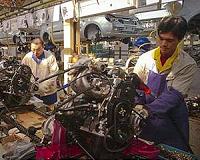
China's manufacturing activity edged down in December, official data showed Sunday, but largely maintained momentum despite increased curbs on heavy industry aimed at taming the country's chronic air pollution.
The manufacturing purchasing managers' index (PMI), a gauge of factory conditions, stood at 51.6 in December, the National Bureau of Statistics (NBS) said, compared to 51.8 in November.
Anything above 50 is considered growth while a figure below that number points to contraction. The number was in line with the expectations of analysts surveyed by Bloomberg News.
China has curbed activity in heavy industries in the country's northeast in an effort to reduce surplus capacity and the heavy smog that typically blankets the region during the late autumn and winter months.
In the face of public discontent over chronic pollution, the world's second largest economy has signalled that it is willing to tolerate a slowdown in economic growth in exchange for an improved environment.
But the move to cut back on heavily polluting industries like steel has so far not had a major impact on the country's manufacturing sector.
"2017 has been a year of stabilisation for the Chinese economy, after a recovery in 2016," Bloomberg News quoted Chen Long, an economist at Gavekal Dragonomics, as saying.
The annual average PMI reading for 2017 was 51.6, the NBS said.
Masayoshi Son: From chicken feed to Japan's richest tycoon
Once asked on Twitter about his receding hairline, Masayoshi Son, founder of Japanese telecoms giant SoftBank, retorted: "My hair is not receding. I'm advancing."
It was a typically bullish remark from the 60-year-old tycoon, listed by Forbes as Japan's richest man with an estimated fortune of $22.2 billion, who has embarked on a furious spree of purchases culminating in Thursday's deal to t … read more
