
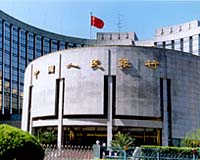
China's central bank governor said Friday he was surprised by the steep rise in bank loans so far this year, but argued it was helpful in boosting fickle confidence.
"Loans in January exceeded our expectations somewhat," Zhou Xiaochuan, governor of the People's Bank of China, told a briefing in Beijing on the sidelines of an ongoing annual full session of parliament.
"But if it can prevent a decline in confidence amid the economic crisis… we'll always have room to fine-tune the monetary policies later," he said.
Chinese banks extended a total of 1.6 trillion yuan (230 billion dollars) in loans in January, heeding calls from policy makers to support measures to boost growth amid the global financial crisis.
In February, the banks extended 800 billion yuan, according to media reports that have not yet been confirmed by official sources.
"If we act too slowly, or if we don't act forcefully enough, it's very likely that we'll see the type of slide in confidence that has happened in other countries," Zhou.
The export-dependent Chinese economy grew by nine percent last year, slipping into single digits for the first time since 2002, as the impact of the global crisis started being felt.
In response, the government unveiled a record four-trillion-yuan stimulus package in November last year.
"At the moment, the economic figures are already showing some signs of stabilising and recovering. This shows the policies are starting to have an impact," Zhou said.
China will publish key macroeconomic data for January and February next week, providing the first full pictures of how the economy has fared so far in 2009.
earlier related report
China indicates prepared to boost stimulus
China could boost a four trillion yuan (585 billion dollar) stimulus package if it proves inadequate in boosting growth during the global financial crisis, the nation's top planner said Friday.
"Whether we want to increase investment, the decision will be based on the development of the situation," Zhang Ping, head of the National Development Reform Commission, said on the sidelines of an ongoing parliamentary session.
"Whether or not (the package) is enough, we have said we need to see how the situation develops, whether or not we take new measures will be decided by carefully watching changes in the situation."
Since China adopted the two-year package during the fourth quarter of 2008, several economic indicators were already showing positive signs, but it was too early to conclude that the stimulus package was adequate, he said.
In his annual report to parliament on Thursday, Prime Minister Wen Jiabao said China was confident of overcoming the global financial crisis, but warned that it posed "unprecedented difficulties and challenges" to the nation.
China would strive to maintain a "fast and steady" eight percent economic growth rate in 2009, with massive social spending targeting the impoverished rural areas and the export sector, he said.
Zhang further added that the stimulus package would help upgrade 10 key industrial sectors and expand infrastructure spending in roads, railways, energy conservation and environmental protection.
China will publish key macroeconomic data for January and February next week, providing the first full picture of how the economy has fared so far in 2009.
