
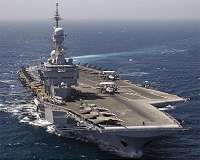
The French aircraft carrier Charles de Gaulle is in drydock in the port of Toulon for an 18-month refit and upgrade.
The carrier has been in service for 15 years and the French Navy said the midlife work will extend her operational life for at least 20 more years.
French shipbuilder DCNS is leading the upgrade and refit project. The French Navy's Fleet Support Service — together with the DGA defense procurement agency — will ensure quality control of the work.
Beyond standard maintenance operations, including refueling its nuclear reactor, the project will modernize the ship's combat system to maintain and increase interoperability with allied navies and allow the ship's transition to the "All Rafale" air wing.
China makes progress on second aircraft carrier
Dalian, China (UPI) Feb 8, 2017 –
China is advancing through the production of its second aircraft carrier, photos taken at the vessel's construction site in the port city of Dalian reveal.
The developing vessel has not been formally named, and is currently referred to as the 001A. Once complete, the ship will be China's first indigenous carrier.
Chinese state media reports suggested the carrier was expected to be complete in the first half of 2017 ahead of officially joining the navy in 2019. However, government officials have not provided an official timeline.
Beijing confirmed in late December China is building its second carrier. The announcement followed a video release by the Chinese military showing off the capabilities of the Liaoning, the country's only operational carrier.
Liaoning, named after a Chinese province, was adapted from a Soviet-era vessel Beijing purchased from Ukraine in 1998. While the country's media reports the vessel has only been used for training missions, Times of India reports Liaoning's successor may be used to patrol the disputed South China Sea.
Defense officials in the United States and allied countries are keeping a close watch on China's aircraft carrier program, which the Pentagon contends threatens to offset the balance of power in the South China Sea.
The region serves as a hub of economic transit, and includes territories disputed by China and five other countries.
