
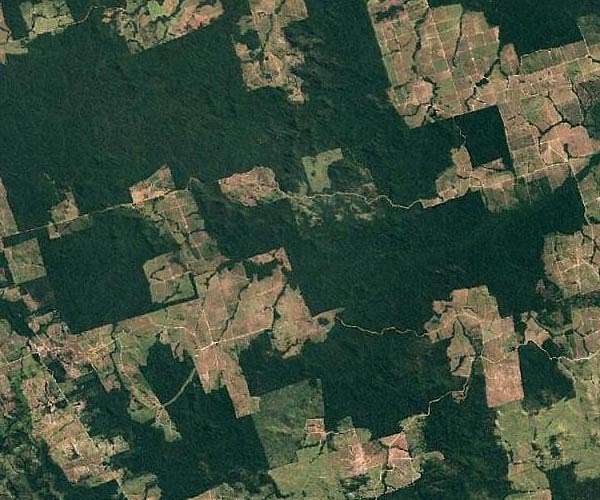
South American politicians and financiers urged new forms of sustainable forestry in the Amazon rainforest at the World Economic Forum in Davos, saying it was the only way to halt over-exploitation.
"It's all about regulation, legislation and putting the ground for the people from the forest to become entrepreneurs. And they really want that," said Gustavo Montezano, president of the Brazilian Development Bank (BNDES).
Some 60 percent of Brazil's territory is in the Amazon basin, and the bank is now financing efforts to reforest parts of it after decades of people believing that "destroying the forest was creating economic value," Montezano said.
Stretching across 7.4 million square kilometres (three million square miles) and into nine countries, the Amazon basin covers around 40 percent of the South American continent.
Around 34 million people are estimated to live in the region, two-thirds of them in towns and cities.
Calls have grown recently to strengthen the Amazon Cooperation Treaty Organization (OTCA), which has existed since the 1970s but still does not include all the region's countries.
Colombian President Ivan Duque said in Davos that a carrot-and-stick policy should be used to both punish deforestation and support sustainable cultivation of fruits, including the copoazu — similar to the cocoa tree — acai or camu camu.
Peru is the South American nation with the second-largest Amazon territory after Brazil, and Vice President Dina Boluarte said this week that it had been "a region historically forgotten by the state".
She called for fruit grown in the region to be bought at "a fair price".
It will be up to governments to make bioeconomy — sustainable exploitation of natural resources — a real alternative to forest-destroying cattle ranching and mining.
– Gaps and contradictions –
A study by Venezuelan economist and Harvard University professor Ricardo Hausmann, who served as a minister in the 1990s, shows that road construction by local governments tends to encourage land-intensive ranching.
"90 percent of deforestation happens within 10 kilometres of tertiary roads. Who builds tertiary roads? Mayors and governors," Hausmann said.
He added that the issue highlights contradictions between national policy to protect the forest and local measures.
Further concerns extend to so-called "biopiracy", or exploitation of resources like medicinal plants by large companies — with knock-on effects for both the ecosystem and indigenous people.
At the global level, there are still too many holes in regulation of carbon emissions to limit deforestation.
The price for emitting a tonne of carbon dioxide (CO2) is not yet high enough to deter activities harmful to the Amazon.
"I think that if the price is right, people stop what they are doing. Changing incentives are going to be more effective than coercion," said Mario Mesquita, chief economist at Brazilian bank Itau Unibanco.
Even given all the challenges, the governor of Brazil's acai-producing Para state, Helder Barbalho, said he believed it was still possible to "reconcile people with the economy" to protect the natural environment.
pc/tgb/lth/spm
ITAU UNIBANCO HOLDING
