
A new study led by the Department of Land Surveying and Geo-informatics at The Hong Kong Polytechnic University (PolyU) has revealed a significant depletion of global soil moisture, pushing large volumes of land water into the oceans and contributing to rising sea levels. Over the past 40 years, the research team, in collaboration with international experts, utilized space geodetic observations and global hydrological change data to assess shifts in terrestrial water storage. Their findings indicate that this rapid moisture loss, observed from 2000 to 2002, resulted in a net transfer of 1,614 billion tons of water to the oceans, contributing approximately 4.5mm to global sea levels – double the annual impact of Greenland ice melt.
The study also highlights the critical role of satellite altimetry and gravity missions, including the Gravity Recovery and Climate Experiment (GRACE) and GRACE Follow-On, in capturing continental-scale terrestrial water variations. By integrating this data with global mean sea levels and polar motion records, the researchers developed a more accurate model for understanding long-term hydrological changes. The study shows that from 2003 to 2021, global average soil moisture significantly declined, correlating with a 58cm shift in the Earth's pole toward 93 East Longitude between 2003 and 2011, reflecting mass redistribution within the Earth system.
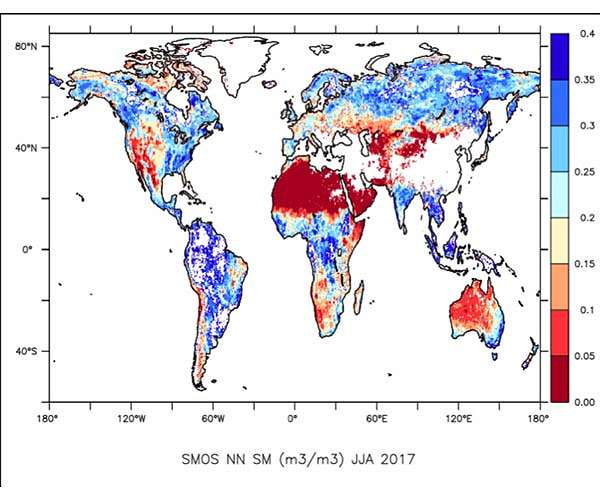
Additionally, the study notes that precipitation deficits, coupled with stable evapotranspiration rates driven by global warming, are key drivers behind this extensive terrestrial water loss. Regional analyses using ERA5-Land soil moisture data from the European Centre for Medium-Range Weather Forecasts confirm that Africa, Asia, Europe, and South America have all experienced substantial water storage declines over the past two decades. These regions have seen extensive drying, particularly in East and Central Asia and Central Europe, following the sharp water storage losses recorded between 2000 and 2002.
The findings underscore the importance of improved land surface models that account for regional irrigation, global greening, and changing rainfall patterns to provide a more comprehensive understanding of these long-term changes.
Prof. Jianli Chen, a core member of the PolyU Research Institute for Land and Space, stated, "Sea level change and Earth rotation serve as indicators of large-scale mass changes in the Earth system. Accurately measured sea level change and variation in Earth rotation provide a unique tool for monitoring large-scale mass changes in the global water cycle. By integrating multiple modern space geodetic observations, it enables comprehensive analysis of the driving factors behind changes in terrestrial water storage and sea level rise. This, in turn, provides reliable data for climate and Earth system science experts to further investigate drought issues, aiding authorities in formulating water resource management and climate change mitigation strategies to address new challenges posed by climate change."
Research Report:Abrupt sea level rise and Earth's gradual pole shift reveal permanent hydrological regime changes in the 21st century
