
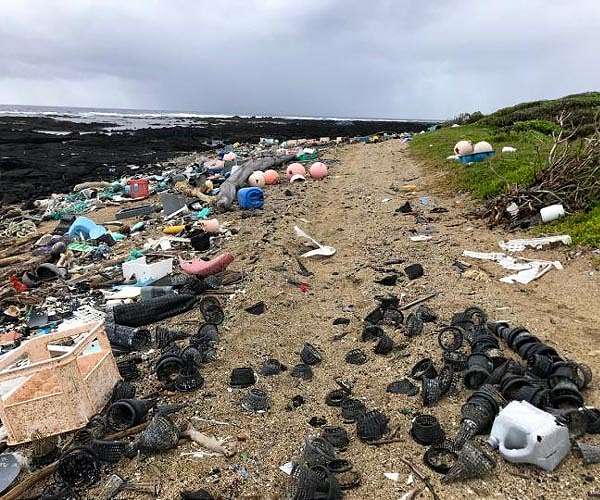
The coastline of the United States is relatively clean compared to other parts of the world, but new research suggests the U.S. is one of the world's top contributors to coastal plastic pollution.
The U.S. exports large amounts of plastic waste. Previous studies have ignored plastic scrap exports, offering the impression that the United States was effectively collecting, disposing and recycling its plastic waste, researchers have said.
According to a new study, published Friday in the journal Science Advances, more than half of the plastic waste collected for recycling in the U.S. — 1.99 million metric tons of 3.91 million metric tons — is shipped out of the country.
Researchers found the vast majority of exported plastic scraps, 88 percent, ends up in countries that are struggling to adequately manage plastic waste. Environmental scientists determined at least 1 million metric tons of plastic waste exported by the U.S. ends up polluting environments abroad every year.
"For years, so much of the plastic we have put into the blue bin has been exported for recycling to countries that struggle to manage their own waste, let alone the vast amounts delivered from the United States," study lead author Kara Lavender Law said in a news release.
"And when you consider how much of our plastic waste isn't actually recyclable because it is low-value, contaminated or difficult to process, it's not surprising that a lot of it ends up polluting the environment," said Law, a research professor of oceanography at the Sea Education Association.
Researchers also determined that a small but not inconsequential amount of plastic waste collected in the U.S. each year — 2 to 3 percent — is littered or illegally dumped.
After accounting for exported waste, as well as littered or illegally dumped domestic waste, researchers determined the U.S. was responsible for 2.25 million metric tons of plastic pollution in 2016, the last year for which pollution data is readily available.
Roughly two-thirds of the plastic polluted by the U.S. ends up in coastal environs, according to the new study — making the U.S. the world's third largest producer of coastal plastic pollution.
Despite accounting for just 4 percent of the world's population, the U.S. is responsible for 17 percent of the world's coastal plastic pollution.
"The United States generates the most plastic waste of any other country in the world, but rather than looking the problem in the eye, we have outsourced it to developing countries and become a top contributor to the ocean plastics crisis," said study co-author Nick Mallos.
"The solution has to start at home. We need to create less, by cutting out unnecessary single-use plastics; we need to create better, by developing innovative new ways to package and deliver goods; and where plastics are inevitable, we need to drastically improve our recycling rates," said Mallos, senior director of the Ocean Conservancy's Trash Free Seas program.
The researchers suggest their findings should serve as a wakeup call for U.S. policy makers and industry leaders to take responsibility for the nation's plastic pollution footprint.
"For some time, it has been cheaper for the United States to ship its recyclables abroad rather than handle them here at home, but that has come at great cost to our environment," said study co-author Natalie Starr.
"We need to change the math by investing in recycling technologies and collection programs, as well as accelerating research and development to improve the performance and drive down the costs of more sustainable plastics and packaging alternatives to address the current challenge," said Starr, principal at DSM Environmental Services.
Sri Lanka returns illegal waste to Britain after court order
Colombo (AFP) Oct 31, 2020 –
Sri Lanka has started shipping 242 containers of hazardous waste, including body parts from mortuaries, back to Britain after a two year court battle by an environment watchdog, officials said Saturday.
Several Asian countries have in recent years been pushing back against an onslaught of international refuse from wealthier nations and have started turning back the unwanted shipments of garbage as they battle against being used as the world's trash dump.
The first 20 containers of medical waste, which included body parts from mortuaries, were loaded on the MV Texas Triumph on Friday and another 65 will be sent within a week, customs spokesman Sunil Jayaratne said.
"The balance will be shipped as soon as another vessel is available," Jayaratne said.
Sri Lanka's court of appeal two weeks ago ordered the repatriation of the bio-waste from hospitals and tonnes of plastic waste imported in violation of local and international shipping regulations.
The imports arrived between September 2017 and January 2018 and the Centre for Environmental Justice (CEJ) had petitioned courts to get it rejected.
Customs did not reveal the type of waste, but officials had said it included rags, bandages and body parts from mortuaries.
In September, 260 tonnes of separate waste in another 21 containers was sent back after Britain agreed to take it back.
Local authorities discovered the new waste after the legal action was started against the 242 containers held in Colombo port and a free trade area near the capital.
Sri Lanka's customs maintained that all the containers had been brought into the country in violation of international law governing the shipment of hazardous waste, including plastics.
A Sri Lankan investigation last year into nearly 3,000 tonnes of illegally imported hazardous waste found the importer had reshipped about 180 tonnes to India and Dubai in 2017 and 2018.
Besides Sri Lanka, the Philippines, Indonesia and Malaysia have also returned hundreds of container-loads of refuse back to their countries of origin.
