
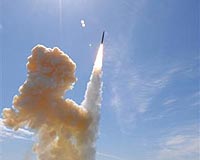
The US military chief Monday said he was hopeful Washington and Warsaw could wrap up talks on a deal tied to a anti-missile plan opposed by Russia but which Washington says is needed to counter threats by Iran.
"There are very important ongoing negotiations," Admiral Mike Mullen told reporters, referring to talks on a Status of Forces Agreement (SOFA) governing the presence of US troops on Polish soil.
"I'm not just hopeful, but also optimistic, that they can move forward," he said.
Mullen, chairman of the US Joint Chiefs of Staff, was in Warsaw to meet with his Polish counterpart General Franciszek Gagor.
In 2008, Warsaw and Washington struck a deal on deploying 10 US long-range interceptor missiles in Poland as part of a global air-defence system.
They also inked a related accord on boosting Poland's air defences by deploying Patriot missiles.
Before the deals can come into force, however, the two allies have to complete their SOFA negotiations.
Gagor noted the talks were in the hands of defence and foreign ministry negotiators from both sides, rather than the military.
"They are dealing with the political and legal issues. They are proceeding with that," he said.
According to the previous US administration of George W. Bush the anti-missile system — meant to be ready by 2013, and including a radar base in the Czech Republic — aimed to thwart attacks by "rogue states", notably Iran.
But Moscow was enraged by the plans in its Soviet-era stamping ground, and threatened to train nuclear warheads on Poland and the Czech Republic, which broke free from the communist bloc in 1989 and joined NATO 10 years later.
Bush's successor Barack Obama this year launched a review of the controversial system, saying it must be cost-effective and proven to work.
The issue is expected to be on the table during Obama's July 6-8 visit to Moscow. Russian officials have said that if Washington gives way on the shield, Moscow may agree to a reduction of both nations' nuclear arsenals.
Obama has nonetheless said Washington would move forward with the system as long as there was an Iranian missile threat — something Mullen underscored.
"Clearly the United States is both concerned about the growing missile capabilities, and the destabilising aspect of those capabilities, that are coming out of Iran, and is very committed to looking for solutions that best resolve and protect against that threat," Mullen said.
Earlier this month, the Polish government complained Washington was failing to give it a clear indication on the future of the shield and the Patriots.
"It would be weeks to months after the completion of a (SOFA) agreement that we would be able to deploy the first Patriot battery," said Mullen, noting that Washington's initial plan is to provide one for training purposes.
Poland has insisted it wants a fully-operational battery that can be integrated directly into the nation's air-defence system.
Gagor, however, did not stoke the spat.
"The Polish military is looking forward to the battery being deployed in Poland… I believe that the battery will be in Poland sooner rather than later," he said.
Share This Article With Planet Earth
