
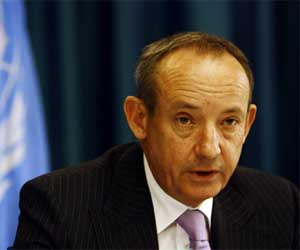
Yvo de Boer, who said Thursday he would quit the UN's top climate post on July 1, drew fire from all sides during his more than three-year tenure.
From the sidelines, he was accused of partisanship, tactical missteps and even lack of charisma.
Dubbed the "crying Dutchman" following a brief breakdown at a critical 2007 climate meet in Bali, some critics even called him the "prince of darkness" due to his sombre mien and alleged lack of transparency.
Complaints crescendoed at the December Copenhagen climate summit which, under his co-stewardship, came within a hair's breadth of collapse.
"Since Bali, there has been a lack of confidence among the Parties. Yvo has come in for a lot of criticism," said a senior European diplomat, asking not to be named.
But the truth may simply be that de Boer was given Mission Impossible, climate veterans said.
"There is probably no perfect person for this job, it's a task for a superman," said Wendel Trio, the head of Greenpeace International's political and business Unit.
"He was very exposed" in a very tough and important job, France's climate ambassador, Brice Lalonde, told AFP.
Appointed executive secretary of the UN Framework Conference on Climate Change (UNFCCC) in September 2006, the former Dutch housing official quickly became an ardent champion of the fight against global warming.
His persistent message was that a worldwide pact had to be based on equity.
Rich nations bore historical responsibility for greenhouse-gas emissions while poor nations would be worst affected by changed weather systems, he argued.
It was a major — and risky — change in profile for what had been a low-key job which barely registered on the public radar screen.
"He made huge efforts to engage first Kofi Annan and then Ban Ki-moon on the climate issue," said a European negotiator speaking on condition of anonymity, referring to the former UN secretary general and his successor.
Greenpeace International described de Boer as "a passionate and sometimes emotional advocate" for a global climate treaty.
De Boer's proactive approach, however, did not sit well with some nations, already struggling to find common ground on an issue that has defied consensus.
He is seen by some industrialised nation diplomats as having overstepped his mandate.
"Yvo forgot that he was there to manage a neutral UN process," said the European diplomat.
"By the time Copenhagen came, he no longer convinced anyone — he managed to anger most people over the last few years. At the end of the day, he didn't have many allies left."
As a diplomat's child who witnessed poverty in developing countries, de Boer admitted in an interview last year that he had been criticised for pitching up for vulnerable nations.
"I know that people complain about that," he told AFP. "But what is sometimes forgotten is that a large part of this process is about how 145 very poor countries are going to adapt to the impact of climate change."
De Boer said on Thursday that he had decided to move to the private sector, but it is likely that there was as much push and pull in his decision.
Only weeks ago, his office told AFP that he had no intention of leaving his post, and expected it to be renewed in September, when his mandate would have normally expired.
Once asked whether he perceived his role in the 194-nation talks as closer to that of a symphony conductor or a referee, he rejected both metaphors.
"In my first meeting with staff when I joined the secretariat, I described my role as that of the butler," he recalled.
"The butler's role is to make sure that the household is well run and that the family are in a position to make sensible decisions."
Now the role of climate majordomo will fall to someone else, probably from a developing nation, diplomats said.
Share This Article With Planet Earth
