
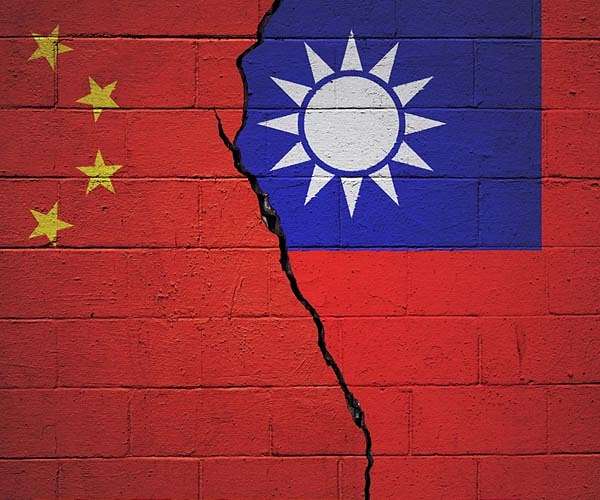
Taiwan on Tuesday announced an extension in mandatory military service from four months to one year, citing the threat from an increasingly hostile China.
Beijing considers self-ruled, democratic Taiwan a part of its territory, to be taken one day, by force if necessary, and the island lives under the constant fear of a Chinese invasion.
China's sabre-rattling has intensified in recent years under President Xi Jinping, and Russia's invasion of Ukraine has further deepened worries in Taiwan that Beijing might move similarly to annex the island.
China's "intimidation and threats against Taiwan are getting more obvious", President Tsai Ing-wen told a press conference after a high-level government meeting on national security.
"No one wants war… but my fellow countrymen, peace will not fall from the sky."
"The current four-month military service is not enough to meet the fast and ever-changing situation," she said. "We have decided to restore the one-year military service from 2024."
The extended requirement will apply to men born after January 1, 2005, Tsai added.
Mandatory service used to be deeply unpopular in Taiwan, and its previous government had reduced it from one year to four months with the aim of creating a mainly volunteer force.
But recent polling showed more than three-quarters of the Taiwanese public now believes that is too short.
Tsai described the extension as "an extremely difficult decision… to ensure the democratic way of life for our future generations".
"We can only avoid a war by preparing for a war and we can only stop a war by being capable of fighting a war."
– Outgunned –
The prospect of a Chinese invasion has increasingly worried Western nations and many of China's neighbours.
Xi, China's most authoritarian leader in decades, has made clear that what he calls the "reunification" of Taiwan cannot be passed on to future generations.
Taiwan and China split at the end of the Chinese Civil War in 1949, and Tsai has said becoming a part of China is not acceptable to the people of the island.
Taiwan is a mountainous island and would present a formidable challenge to an invading force, but it is massively outgunned with 89,000 ground forces compared with China's one million, according to a Pentagon estimate released last month.
Beijing also has a huge advantage in military equipment.
Taiwan has stepped up reservist training and increased its purchases of warplanes and anti-ship missiles to bolster its defences. But experts have said that is not enough.
The island needs to go further than just extending mandatory service, said J. Michael Cole, a Taipei-based analyst.
"Given the threat level and the example of Russia in Ukraine, I hope the Taiwanese public realises that such measures are needed," he told AFP.
"The threat that Taiwan faces is just as existential."
The military service announcement on Tuesday came two days after Chinese military exercises near Taiwan, which were held in response to what Beijing described as "provocations" and "collusion" between Washington and Taipei.
Taiwan says China deployed 71 warplanes in weekend war drills
Taipei (AFP) Dec 26, 2022 –
China deployed 71 warplanes in weekend military exercises around Taiwan, Taipei's defence ministry said Monday, including dozens of fighter jets in one of the biggest daily incursions to date.
The People's Liberation Army said it had conducted a "strike drill" on Sunday in response to unspecified "provocations" and "collusion" between the United States and the self-ruled island.
Data from Taiwan's defence ministry showed those drills were one of the largest since they started releasing daily tallies.
In a post on Twitter, Taiwan said 60 fighter jets took part in the drills, including six Su-30 warplanes, some of China's most advanced.
Moreover, 47 of the sorties crossed into the island's air defence identification zone (ADIZ), the third-highest daily incursion on record, according to AFP's database.
Chiu Tai-san, head of the Mainland Affairs Council (MAC), Taiwan's top China policy-making body, expressed "strong dissatisfaction" at the latest incursions during a parliament session on Monday.
Taiwan lives under constant threat of invasion by China, which claims the democratic island as part of its territory, to be taken one day.
Beijing has ramped up military, diplomatic and economic pressure on Taiwan under President Xi Jinping as relations have deteriorated.
One of the pressure tactics China has increasingly used is probing Taiwan's ADIZ with its warplanes.
According to an AFP database, there have been more than 1,700 such incursions so far this year, compared with 969 in 2021. Taiwan's defence ministry said it recorded around 380 incursions in 2020.
China did not specify the number of aircraft mobilised for Sunday's exercises, nor the exact location of the manoeuvres.
Taiwan's daily tally showed most of the incursions crossed the "median line" which runs down the Taiwan Strait separating the two sides, while a smaller number went through Taiwan's southwestern ADIZ.
– Record bomber incursion –
Many nations maintain air defence identification zones, including the United States, Canada, South Korea, Japan and China.
They are not the same as a country's airspace.
Instead, they encompass a much wider area, in which any foreign aircraft is expected to announce itself to local aviation authorities.
Taiwan's ADIZ is much larger than its airspace. It overlaps part of China's ADIZ and even includes some of the mainland.
The PLA said Sunday's exercises were "a firm response to the escalating collusion and provocations by the US and the Taiwanese authorities".
Beijing has been incensed by US President Joe Biden's handling of Taiwan — especially after he said Washington would defend it militarily if attacked by China.
Taiwan's defence ministry said on Sunday that cooperation between Taipei and Washington would "help (maintain) freedom, openness, peace and stability" in the Indo-Pacific region.
The prospect of a Chinese invasion has increasingly rattled both Western nations and many of China's neighbours.
Xi, China's most authoritarian leader in decades, has said that the process of what he calls the "reunification" of Taiwan cannot be passed on to future generations.
Russia's invasion of Ukraine has also heightened fears China might try something similar.
The United States has stepped up support for Taiwan including a bill this month that authorised $10 billion in military aid, to which Beijing expressed "strong opposition".
Tensions peaked in August during US House Speaker Nancy Pelosi's trip to Taiwan, with the PLA staging huge military drills around the island in protest.
Military flights into the ADIZ are seen as a way to both wear down Taiwan's ageing fleet of fighters as well as probe its defensive responses.
There has also been an increase in sorties by China's nuclear-capable H-6 bombers.
China this month sent a record 18 H-6 bombers into the southwestern ADIZ in the largest daily incursion to date.
