
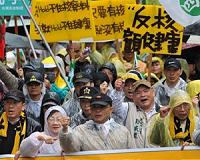
Taiwan's president Tuesday offered to talk with protesters in a concession to student demonstrators who have occupied parliament for the past week in a bid to stop the government from ratifying a contentious trade agreement with China.
The invite was apparently aimed at preventing any further escalation of the demonstration, after more than 100 people were injured Monday when police used water cannon to disperse hundreds of protesters who had also stormed the nearby government headquarters.
"As the continued paralysing of parliament has impacted the operation of parliament and government, President Ma Ying-jeou is willing to invite student leaders to the presidential office to discuss the service trade agreement… so as to help parliament resume operation," Ma's spokeswoman Li Jia-fei said in a statement.
The protesters said they were willing to accept the invite, but demanded "concrete discussions" with the president on passing new legislation to monitor agreements with China.
"We ask the parliament to return the service trade pact to the cabinet until new legislation to monitor cross-strait agreements is passed, and then the parliament can review the pact," said student leader Chen Wei-ting.
In the first ever such protest in Taiwan, angry student protesters occupied parliament on Tuesday last week. They had initially demanded that the government honour a pledge to review the pact clause by clause.
The pact, signed in July, is designed to open up further trade in services between China and Taiwan, which split 65 years ago after a civil war.
But the protesters say the deal will damage Taiwan's economy and leave it vulnerable to political pressure from China.
An official from the presidential office said arrangements are underway for the meeting between Ma and the students, but the date is not yet set.
Premier Jiang Yi-huah on Saturday met with the demonstrators outside parliament, but they did not reach any agreement.
Ma has warned that failure to ratify the pact would be a grave setback to trade-reliant Taiwan's efforts to seek more free trade agreements and avoid isolation as regional economic blocs emerge.
The pact passed its first parliamentary hurdle on Monday last week after it was approved by a committee, but the opposition insisted the approval was illegal.
The deal is a follow-up agreement to a sweeping Economic Cooperation Framework Agreement signed in 2010 to reduce trade barriers between China and Taiwan.
Ma has overseen a marked thaw in relations with Beijing since he came to power in 2008, pledging to strengthen trade and tourism links.
But China still considers Taiwan as part of its territory awaiting reunification — by force if necessary.
