
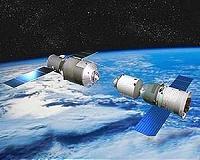
China's next astronauts will launch this year aboard the Shenzhou 11 spacecraft. Their target will be the Tiangong 2 space laboratory, which will probably launch at least a few weeks before them. The crew will almost certainly consist of three astronauts, with a previously flown astronaut as the commander. Exactly who these three crewmembers will be is still unclear, but the older, twice-flown astronauts can probably be ruled out.
Another important issue is also unresolved. How long will the astronauts inhabit the Tiangong 2 space laboratory?
The crew of Shenzhou 11 will be the only astronauts to visit Tiangong 2, an unusual departure from the mission of the Tiangong 1 module. Two crews were sent to Tiangong 1. Plans for just one crew expedition to the next Tiangong seem strange at face value, but there could be good reasons for it. The Tiangong program is all about staging test missions to prepare for the Chinese Space Station.
There could be no need for a second crew to board Tiangong 2 if the first expedition is successful. Furthermore, time is running out for the Tiangong program. China seems keen to start launching the Chinese Space Station as soon as possible. The sooner the Tiangong program wraps up, the sooner China can focus on the Station. China has announced plans for a 2018 launch of the first module of the Chinese Space Station, which will grow as more modules are added.
This analyst also speculates that crew endurance and logistics are another important reason for the single crew. China probably expects that the Shenzhou 11 astronauts will be "stayin' alive" aboard Tiangong 2 for much longer than any previous Chinese space mission.
How long could these astronauts live aboard the laboratory? Tiangong 2 is a small module, and cannot realistically support the multi-month expeditions that are staged to the International Space Station. But we could expect a residency of roughly one month, at least.
This estimate is based on the crew endurance we saw for Tiangong 1. The two expeditions were roughly the equivalent of a one-month stay. Tiangong 2 should be able to do at least as well as this. Furthermore, Tiangong 2 is expected to have a regenerative life-support system. This should extend the oxygen supply. It is not clear if Tiangong will recycle its water, as the International Space Station does. However, there will be no production or resupply of food. Thus, supplies for the astronauts to eat and drink could be the limiting factors on crew endurance.
China also plans to launch the first Tianzhou cargo ship to dock with Tiangong 2 at some point. Could supplies on board this vessel help with a longer mission?
Doubtful. This analyst expects that Tianzhou 1 will simply stage docking experiments with Tiangong 2 and probably boost its orbit with its own thruster firings. This will all happen when there is no crew on board Tiangong 2, and probably take place after the astronauts have come and gone. Tiangong 2 only has one docking port. It's not possible to have a Shenzhou crew ship and a Tianzhou cargo ship docked at the same time. It's a bit ironic, but this huge logistics ship will probably carry no crew supplies at all.
China could elect to carry some additional supplies aboard the Shenzhou 11 spacecraft, which would be consumed while the astronauts were aboard Tiangong 2. This could allow the total mission duration to be well over a month.
It would be worthwhile for China to stage a single extended mission. This would hugely extend the record for a Chinese space mission, and allow the physiological effects of an extended flight to be studied. Missions of several months are slated for the Chinese Space Station. Going for more than a month on Tiangong 2 would be a bridge to this goal.
China could fly an even longer mission by reducing the crew size to two, thus conserving the logistics. But this seems unlikely. China seems to have settled on three-person crews for its Tiangong missions. We can also expect three-person crews for the Chinese Space Station, at least in its first phases of operations.
