
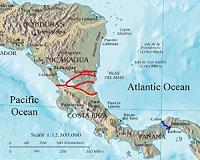
Work on an ambitious, $50-billion inter-ocean canal Nicaragua wants to build to rival the Panama Canal has been put back nearly a year, the Hong Kong company involved said, citing delays to an environmental study.
The head of the project for the Hong Kong Nicragaua Development (HKND) group, Bill Wild, admitted to Panama state television network Canal 8 that "we are behind schedule".
He said the lateness of the environmental impact study was to blame.
"The study was meant to have been approved in December 2014, but it finally only happened in November this year. So, 11 extra months were taken to approve the study," Wild said.
But he added that the scheduling slip "will not hinder us, because many suggestions were made during this period and we had to take the necessary time to correctly do this study."
Niacaragua in 2013 gave HKND a 50-year concession to run the canal in return for the company getting it built by 2020.
Surveying work for the artificial waterway, which is to be three times the length of the Panama Canal, started a year ago. HKND's boss, Chinese telecoms billionaire Wang Jing, promised construction would start this year.
But last week HKND announced that excavation work and the building of locks would start only towards the end of 2016. It did not explain why.
Studies on the environmental and impact of the canal were carried out for HKND by a British firm, Environmental Resources Management (ERM), and in June handed to the government for review and approval.
ERM determined that the canal would have "significant" consequences but, if executed correctly, would have a "positive" impact for the country.
The government approved the study on November 5.
Wild said that, with that, "we are now in the conception phase" of getting the work under way.
The Nicaragua canal is to cut across the southern part of Nicaragua, opening another passage between the Atlantic and Pacific Oceans.
It is notably to run through Lake Nicaragua, the largest freshwater lake in Central America, sparking criticism from environmental groups which fear an ecological disaster.
