
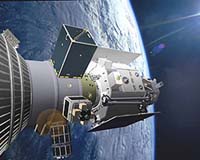
Spacehab congratulates all those involved in the successful maiden voyage of the Evolved Expendable Launch Vehicle (EELV) Secondary Payload Adapter (ESPA) ring technology on the recent Space Test Program-1 (STP-1) mission.
The ESPA ring, designed to integrate multiple smaller satellites onto EELV-class rockets, made it possible for a total of six satellites to be delivered into two different low-Earth orbits during the U.S. Air Force's recent mission. Launched aboard an Atlas V rocket at Cape Canaveral Air Force Station, the four 'ESPA-class' satellites deployed without impact to the primary payloads, Orbital Express' two-satellite configuration, within 66 minutes of the picture-perfect night launch.
"This flight represented a significant advancement in space technology," said Spacehab President and CEO, Thomas B. Pickens, III. "STP-1 demonstrated the deep devotion and drive for success by the many government, university, and industry groups involved. A true breakthrough innovation, the ESPA command performance paves the way for repeat missions utilizing and refining this unique payload integration technology," said Pickens.
The Cape Canaveral-based Spacehab Payload Processing Facility (SPPF) team was proud to be involved in the ESPA achievement through the fabrication and integration of critical flight qualified hardware directly onto the ESPA ring. "I'm always so impressed with the SPPF team's unique and specialized capabilities," said Pickens. "Fifteen years of flawless cargo integration experience has earned these professionals a reputation for worldwide excellence in the field. They consistently exceed the customer's expectations and are known in the industry as the gold standard for cargo integration," said Pickens.
For final integration just months before scheduled liftoff, STP-1 was also supported by Spacehab's subsidiary, Astrotech Space Operations, providing payload facilities and pre-launch support for all six satellites and their teams. As part of this critical service, Astrotech's personnel were also responsible for loading the propellant on the Orbital Express. "This was not a routine satellite launch and deployment and I was very proud to see our teams play such vital and varied roles in such an important mission. I congratulate all the teams for an outstanding accomplishment," Pickens concluded.
