
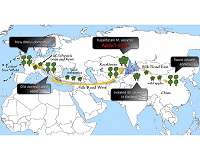
New research suggests nomadic populations in Medieval Central Asia, between the 2nd and 16th centuries AD, ate more dynamic diets than sedentary Silk Road populations.
Though most research into the Silk Road frames the phenomenon in terms of traded goods, the route through Medieval Central Asia was formed by interactions between nomadic and sedentary population.
Isotopic analysis of human remains has helped scientists determine the dietary habits of different Silk Road populations.
"The 'Silk Road' has been generally understood in terms of valuable commodities that moved great distances, but the people themselves were often left out," Taylor Hermes, a researcher at Kiel University in Germany, said in a news release. "Food patterns are an excellent way to learn about the links between culture and environment, uncovering important human experiences in this great system of connectivity."
The new research, published this week in the journal Scientific Reports, suggests nomads were the original foodies, adopting a variety of food traditions and tapping into a range nutritional resources. Those living in permanent settlements were more stuck in their ways, mostly reliant on local grains.
"Historians have long thought that urban centers along the Silk Road were cosmopolitan melting pots where culinary and cultural influences from far off places came together, but our research shows that nomadic communities were probably the real movers and shakers of food culture," Hermes said.
Scientists analyzed isotopic ratios inside human remains collected from a variety of nomadic and urban burial sites in Kazakhstan, Uzbekistan and Turkmenistan, all of them dated between the 2nd to 13th centuries AD. The burial sites were linked with a range of community and population types, as well a variety of topographies and climates.
"By measuring carbon isotope ratios, we can estimate the percentage of someone's diet that came from specific categories of plants, such as wheat and barley or millet," Hermes said. "Millets have a very distinctive carbon isotope signature, and differing ratios of nitrogen isotopes tell us about whether someone ate a mostly plant-based diet or consumed foods from higher up on the food chain, such as meat and milk from sheep or goats."
The results of the isotopic analysis not only challenge the idea of pastoral nomads eating only the meat and milk of their livestock, they also suggest nomadic populations were essential to the cross-cultural exchange along the Silk Road.
According to Michael Frachetti, associate professor of anthropology at Washington University, St. Louis, mobile communities were "the essential fiber that fueled social networks and vectors of cultural changes."
Egyptian mummy discovered in coffin thought to be empty
Washington (UPI) Mar 27, 2018 –
When a group of Australian researchers at the University of Sydney's Nicholson Museum pried open a 2,500-year-old coffin belonging to an Egyptian woman named Mer-Neith-it-es, they expected to find only a few bones and bandages. They assumed the coffin was empty.
Instead, the researchers found an Egyptian mummy.
The coffin, boasting hieroglyphics dated to 600 BC, was one of four sarcophagi collected in Egypt and shipped back to Australia by the museum's founder, Sir Charles Nicholson, in 1860. Upon its discovery, Nicholson made a note that the coffin was empty. He assumed it had been raided.
Over the last century-and-a-half, researchers at the museum have ignored the coffin in favor of more interesting finds — coffins with more ornate decorations and with mummies inside.
It turns out, Nicholson was mistaken.
Though scientists were surprised to find such a sizable jumble of bones and bandages, they couldn't be certain about what they were looking at. The mummy's remains were a jumbled mess, but CT scans helped them sort it out.
"A leg bone lies against the coffin's shoulder, rib bones jut erratically from bandages, part of the jaw lies near the coffin's feet," museum curator Jamie Fraser wrote in the March issue of Muse. "Hundreds of tiny faience beads, once laid over the mummy as a beaded net, are scattered throughout."
Though the tomb was certainly not empty, Nicholson was correct to suggest it had been ransacked. Advanced imaging, only recently completed, suggests the coffin hosts mixed remains. Scientists are now beginning to sort through the details revealed by the CT scans.
"The scanner detected two mummified ankles, feet and toes, consistent with a single person; the fused ends of some of the bones suggest the person was at least 30 years old," Fraser wrote.
With the state of the tombs' insides thoroughly documented, scientists can now begin to remove and analyze individual bones.
"The excavations within the Mer-Neith-it-es coffin will enable us to handle the bones directly, helping us understand aspects of diet and disease," Fraser wrote.
Whether or not the remains inside the coffin are those of Mer-Neith-it-es or not isn't clear yet, but researchers do have some idea of who she was — evidence suggest the woman was either a priestess or a worshipper.
"We know from the hieroglyphs that Mer-Neith-it-es worked in the Temple of Sekhmet, the lion-headed goddess," Fraser told USA Today. "There are some clues in hieroglyphs and the way the mummification has been done and the style of the coffin that tell us about how this Temple of Sekhmet may have worked."
