
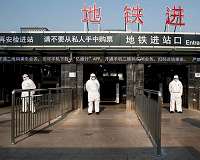
A new coronavirus cluster in a port city in northeast China has spread to other provinces and prompted fresh restrictions, authorities said Tuesday, as Beijing scrambles to prevent a second wave of infections.
China had largely brought the virus under control since it first emerged in the country late last year, through a series of strict lockdowns and travel restrictions.
But in recent months a number of small outbreaks have given cause for concern, with China reporting 68 new infections on Tuesday — the highest daily number since April.
Of those, 57 were in the northwest region of Xinjiang, where an outbreak has seen millions of residents tested and strict lockdowns in the regional capital Urumqi.
Six more cases were also reported in the industrial port city of Dalian, Liaoning province, where a new outbreak first emerged at a seafood processing plant last week. This brings the total number of new infections in Dalian to 44.
Health authorities said the Dalian cluster had now spread to nine cities in five regions across the country, including as far away as the southeast coastal province of Fujian.
Fujian said the provincial capital Fuzhou would enter "wartime mode" after it discovered an asymptomatic patient who had travelled from Dalian, 1,500 kilometres (900 miles) away.
The new measures mean increased scrutiny of travellers who enter the city from nationwide virus hotspots.
A fresh Beijing case reported Tuesday was also linked to an asymptomatic patient who had travelled from Dalian — the first new local case since a cluster in the capital was brought under control in early July.
Beijing began mass testing residents in a suburban housing estate where the patient lives.
Twelve new asymptomatic cases were also recorded in Dalian on Tuesday. China counts asymptomatic cases separately.
The Chinese Super League is currently being played in the city, under strict conditions.
Local health officials in Dalian said Sunday that they would mass-test all six million residents within four days, and announced on Monday that samples had already been taken from 1.68 million people.
Dalian authorities have also banned group celebratory dining activities and ordered customers to display a local "health code" on their phones when entering restaurants.
Meanwhile, health authorities in Shenzhen announced that more than 3,000 locals had been tested as of Tuesday morning, after a Hong Kong truck driver who recently tested positive passed through the city close to the semi-autonomous financial hub.
Hong Kong initially had remarkable success in controlling the outbreak, but local infections have soared over the last month.
Across the mainland, 391 people are still hospitalised with COVID-19, and there have been 83,959 infections in total.
Hong Kong implements tough coronavirus restrictions
Hong Kong (AFP) July 29, 2020 –
Hong Kong is on the verge of a "large-scale" coronavirus outbreak that could overwhelm hospitals, its leader warned Wednesday, as authorities implemented their toughest social distancing measures yet.
From Wednesday all residents in the densely packed city of 7.5 million must wear masks when they leave their homes while restaurants can only serve takeaway meals.
No more than two people from different households can gather in public with fines of up to HK$5,000 ($625) for those who breach the new emergency rules.
The latest measures are a bid to reverse a sudden spike in coronavirus cases that has upended the city's otherwise enviable battle against the deadly disease.
More than 1,000 infections have been confirmed since early July — more than 40 percent of the total since the virus first hit the city in late January.
New daily infections have been above 100 for the past six days.
"We are on the verge of a large-scale community outbreak, which may lead to a collapse of our hospital system and cost lives, especially of the elderly," Chief Executive Carrie Lam said in a statement released on Wednesday to coincide with the new measures.
"In order to protect our loved ones, our healthcare staff and Hong Kong, I appeal to you to follow strictly the social distancing measures and stay at home as far as possible," she added.
During their lunch break on Wednesday, many residents were eating takeaway meals outside in the intense summer heat and humidity.
"It's so hot outside now," a construction worker, who gave his surname as Chow, told AFP as he tucked into a pork chop in an alcove outside a department store.
"Ten minutes after I start work, my shirt is all sweaty," he said, adding he missed the air conditioning of restaurants.
Hong Kong has some of the world's smallest and most expensive apartments. Some residents barely have a kitchen to cook in, making them hugely reliant on cheap eateries.
– From success to sudden surge –
The finance hub was one of the first places hit by the coronavirus when it emerged from China at the start of the year.
It initially had remarkable success in controlling the outbreak — helped in part by a health-conscious public embracing face masks and an efficient track and trace programme, forged in the fires of the deadly SARS virus in 2003.
By June, local transmission had all but ended.
But the virus later sneaked back into the city and began spreading.
Health officials have been scrambling to uncover the source of the latest outbreak.
Some have blamed exemptions from the usual 14-day quarantine that the government granted to "essential personnel", including cross-boundary truckers, air and sea crew and some manufacturing executives.
The government has since tightened restrictions for some of those groups.
Gladys Chan, who was taking her lunch break, said she felt the government had not done enough to monitor those with exemptions.
"I think the government has failed us, especially with this third wave of the pandemic," she told AFP, adding the latest measures were "too little, too late".
As isolation wards fill up, authorities have announced plans to build a temporary 2,000-bed field hospital near the city's airport, something Chinese authorities have offered to help with.
The latest lockdown measures are a new body blow for a city that was already mired in recession thanks to the US-China trade war and months of political unrest last year.
