
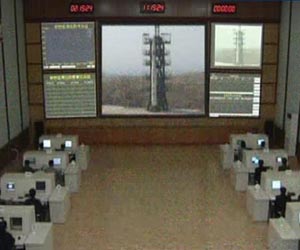
North Korea appears to have moved a medium range missile capable of hitting targets in South Korea and Japan to its east coast, the South's Yonhap news agency reported Thursday.
The movement was detected by both South Korean and US intelligence, Yonhap said, citing military and government sources.
"It appeared that the object was a Musudan mid-range missile," it quoted one South Korean official as saying.
"We are closely monitoring whether the North moved it with a view to actual launch or just as a show of force against the US," the official added.
Japan's Asahi Shimbun newspaper also carried a similar report.
The Musudan missile was first unveiled at a military parade in October 2010 and is believed to have an intended range of around 3,000 kilometres (1,860 miles). However, it is not known to have been tested.
Yonhap cited intelligence sources as saying the North might launch the missile on April 15, the birth anniversary of founding leader Kim Il-Sung.
The South Korean Defence Ministry declined to confirm the report, but stressed that it kept a "24-hour watch" for any potential North Korean missile launches.
"We believe there is always an open possibility for a missile launch and related measures have been prepared," ministry spokesman Wi Yong-Seop told reporters without elaborating.
The United States said Wednesday it was sending ground-based missile interceptors to Guam in response to North Korean threats to strike the Pacific island and other US targets.
A US territory that is home to 6,000 American military personnel, submarines and bombers, Guam lies 3,380 kilometres southeast of North Korea.
Experts say the Musudan could theoretically be pushed to such a range, but the lack of tests means it lacks any proven strike capability, even on targets closer to home.
N. Korea threatens to pull its workers from Kaesong
Seoul (AFP) April 4, 2013 –
North Korea threatened Thursday to pull its 53,000 workers from the Kaesong joint industrial zone with South Korea and close the complex, a day after it blocked access for South Korean personnel.
A spokesman for the North's Committee for Peaceful Reunification of Korea (CPRK) said it was responding to the South Korean defence minister's statement Wednesday that there was a "military" contingency plan to ensure the safety of South Koreans in Kaesong.
"If the South Korean puppets and conservative news media keep badmouthing (us), we will order all our workers to pull out from Kaesong", the spokesman was quoted as saying by the official KCNA news agency.
"The full closure of the complex is set to become a reality," he added.
Pyongyang informed Seoul on Wednesday it was stopping the daily movement of South Koreans to Kaesong, the last real surviving point of contact between the two countries.
The South's Unification Ministry said that as of midday Thursday (0300 GMT), there were 812 South Korean citizens in Kaesong, which lies 10 kilometres (six miles) inside North Korea.
The North has said the South Koreans in the complex could leave when they wanted, but hundreds opted to stay to keep their plants running.
Speaking to South Korean ruling party MPs on Wednesday, Defence Minister Kim Kwan-Jin reassured them that there was a contingency plan, "including possible military action," in the event of the South's citizens coming under threat.
The CPRK spokesman said Kim was "rambling" and warned that any military provocation against the Kaesong complex would result in the "self destruction of the enemy forces."
Kaesong is "teetering on the verge of collapse," he added.
Established in 2004, Kaesong is a crucial source of hard currency for North Korea.
Neither of the Koreas has allowed previous crises to significantly affect the complex, which is the only surviving example of inter-Korean cooperation and seen as a bellwether for stability on the Korean peninsula.
