
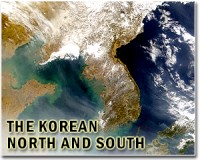
North Korea called Wednesday for a peace pact with the United States, saying this was a "most reasonable and practical" way to end the long standoff over its nuclear weapons programme.
"A peace accord should be concluded between (North Korea) and the US if the nuclear issue on the peninsula is to be settled," the ruling communist party newspaper Rodong Sinmun said in a commentary.
Such an accord is "one of the most reasonable and practical ways" to rid the Korean peninsula of nuclear weapons, it said.
The newspaper urged Washington to roll back its "hostile" policy, insisting this policy had compelled Pyongyang to acquire a nuclear deterrent.
The commentary relayed by the North's official news agency followed its conditional offer last week to return to six-party nuclear disarmament talks.
Leader Kim Jong-Il told visiting Chinese Premier Wen Jiabao his country was ready to return to the talks it quit in April, but only after direct negotiations with the United States to end "hostile relations".
Pyongyang staged its second atomic weapons test a month after quitting the talks.
The North has long wanted dialogue with the United States alone and has been lukewarm about the six-party format, which also includes South Korea, Japan, Russia and China.
Washington has said it is open to bilateral talks but only to bring the North back to the multinational negotiations.
The United States headed a United Nations coalition which fought for South Korea in the 1950-53 war, in which China sent troops to assist the North. The conflict ended in an armistice and without a formal peace treaty.
The newspaper said the armistice had become useless because it could not prevent a second war or armed conflicts on the peninsula.
A six-nation deal reached in February 2007 envisages negotiations on a peace treaty among "directly related parties" along with denuclearisation.
US Assistant Secretary of State Kurt Campbell said Wednesday his country was ready for an "initial interaction" with the North "that would lead rapidly to a six-party resumption of talks".
Campbell told reporters during a visit to Beijing that coordination between the five nations negotiating with the North was better than ever.
"The alignment in views about the six-party framework has been deeply reassuring for us," he added.
US says level of coordination on NKorea near 'unprecedented'
The United States said Wednesday coordination between the five nations trying to get North Korea back to negotiations aimed at ending its nuclear programmes was better than ever.
"There is a virtually unprecedented level of acceptance of basic goals and ambitions associated with the six-party talks and negotiations with North Korea," US Assistant Secretary of State Kurt Campbell told reporters.
"I have rarely seen better coordination between China and the United States in particular," he said on a visit to Beijing partly aimed at laying the groundwork for US President Barack Obama's visit next month.
The six-party negotiations on ending Pyongyang's nuclear programmes are hosted by China, a close ally of North Korea, and also include the two Koreas, the United States, Russia and Japan.
"The alignment in views about the six-party framework has been deeply reassuring for us," Campbell added.
Countries involved in the six-party talks have been at pains to present a united front in a bid to put further pressure on North Korea to come back to the talks it abandoned in April.
The leaders of China, South Korea and Japan on Saturday displayed solidarity at a regional summit, in a move that analysts said could help bring Pyongyang back to the six-party forum.
North Korea said last week during a trip to Pyongyang by Chinese Premier Wen Jiabao that it was willing to return to the six-party talks it quit in April, but only if it first was granted direct negotiations with the United States.
Campbell reiterated on Wednesday that the United States was ready for an "initial interaction" with North Korea "that would lead rapidly to a six-party resumption of talks."
He added any bilateral meetings after that between North Korea and the United States would have to take place within the framework of the talks.
US Secretary of State Hillary Clinton said Tuesday that Washington had no intention of relaxing sanctions against North Korea when asked if the government would support such a move to get Pyongyang back to the talks.
In June, the United Nations Security Council approved tough new sanctions against North Korea after it staged a second nuclear test.
NKorea makes rare apology in talks with SKorea
North Korea Wednesday expressed regret to South Korea over the death of six people swept away by a cross-border flood, in a rare admission of blame by the hardline communist state.
Seoul's presidential office welcomed the statement as a "positive signal" that relations were thawing after months of frosty ties.
The comments came during talks between the two sides on flood-control measures. The meeting went ahead despite the North's short-range missile tests on Monday. Separate talks are scheduled for Friday on family reunions.
In an incident that stirred anger in the South, the North on September 6 released millions of tonnes of water from a dam across the Imjin River, drowning the South Koreans camping or fishing downstream.
The North had said a sudden surge in the dam water level prompted an emergency release, but the South called for an apology and measures to prevent a recurrence.
"Literally speaking, the North expressed regrets and condolences," an official from Seoul's unification ministry told Yonhap news agency, in a briefing on the talks at Kaesong just north of the heavily fortified border.
"But in the general context, we think it's an apology by North Korea with regard to this incident."
The North expressed "deep condolences" to families of the six victims, the official said on condition of anonymity, and reiterated it had been forced to open the floodgates urgently.
The talks ended Wednesday afternoon but the two sides agreed to meet again at a yet-to-be-determined date.
There have been unannounced dam discharges by the North almost every year but this year's was the first to claim lives.
At Wednesday's talks there was "a firm agreement on prior notification from North Korea when it releases water from its dam", Seoul's chief delegate Kim Nam-Sik told reporters.
The two nations have remained technically at war since their 1950-53 conflict ended only in an armistice, and the North rarely expresses regret for its actions.
When a North Korean soldier shot dead a South Korean housewife at a resort in the North in July last year, Pyongyang blamed Seoul for the incident and demanded it apologise. The woman had strayed into a military zone.
On Monday the North test-fired five missiles, the first launches in more than three months, but the unification ministry had said talks would not be affected.
For more than a year Pyongyang was bitterly hostile to the South's conservative government, which scrapped a "sunshine" aid and engagement policy with its impoverished neighbour.
Relations were also strained by the North's nuclear and missile tests in the spring, but it began making peace overtures in August.
In recent weeks it has freed five South Korean detainees, eased curbs on the operations of a joint industrial estate, sent envoys for talks with President Lee Myung-Bak and given the go-ahead for the family reunion programme.
Hundreds of relatives separated since the war held tearful brief reunions two weeks ago, the first such event in two years.
The South, in talks scheduled Friday at Kaesong, will seek to make the reunions a regular event because thousands of people are dying of old age before they get a chance to meet loved ones on the other side of the border.
Rodong Sinmun, newspaper of the North's ruling party, called Wednesday for better inter-Korean relations.
"It is the unwavering will of our republic to proactively realise reconciliation, unity, cooperation and exchanges according to the joint declarations" of past inter-Korean summits, it said.
earlier related report
NKorea says SKorea warships breach border, warns of clashes
North Korea's navy accused South Korea Thursday of sending warships across the border to stir tensions, and said the "reckless military provocations" could trigger armed clashes.
"The reckless military provocations… have created such a serious situation that a naval clash may break out between the two sides in these waters," the naval command said.
The North frequently accuses the South of breaching the disputed sea border in the Yellow Sea, the scene of bloody naval clashes in 1999 and 2002.
But Thursday's bellicose statement follows a series of recent peace overtures from Pyongyang. On Wednesday it had made a rare apology to Seoul for causing a deadly cross-border flood.
The communist state's navy said that on Monday alone the "warmongers" had crossed the border 10 times on the pretext that North Korean fishing boats had intruded into the South's waters.
It said the incursions were part of "premeditated moves to deliberately escalate tension in the waters, a hotbed of conflict, and deteriorate the North-South relations once again.
"It is clear to everyone what consequences the third skirmish in the West Sea of Korea (Yellow Sea) will entail," the command said in a statement on the official news agency, adding that "warnings are bound to be followed by actions".
North Korea refuses to accept the border known as the Northern Limit Line (NLL), which was drawn by United Nations forces after the 1950-53 war.
South Korea's Joint Chiefs of Staff denied the allegations.
"South Korean navy boats have never crossed the NLL into North Korean territorial waters," a spokesman told AFP. "The North, again, is trying to nullify the NLL with its usual claims."
Cross-border military tensions have eased since the North began making peace noises to both Seoul and Washington in August.
Last week the North expressed conditional willingness to return to six-party nuclear disarmament talks, which it quit in April before testing an atomic weapon for the second time.
It insists, however, on first holding bilateral talks with the United States.
On Monday the North test-fired five short-range missiles in what some analysts saw as a show of strength before any US talks.
Seoul's Unification Minister Hyun In-Taek said it was unclear if recent conciliatory gestures indicated a genuine change of heart.
"We are at the moment cautiously observing what the true intention of North Korea is," he said in a speech to the European Union Chamber of Commerce.
Hyun said it was still unclear whether the North had given an explicit commitment to return to six-party talks.
While more and more people worldwide were becoming pessimistic about denuclearisation, he said, "I believe in the end that denuclearisation of North Korea will be possible.
"If the international community continues a united and coordinated stance North Korea will have no other choice but to denuclearise."
Share This Article With Planet Earth
