
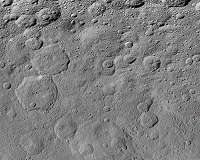
NASA honored Kwanzaa this week with an image of a mountain on the dwarf planet Ceres named for the African-American holiday, which is celebrated from Dec. 26 to Jan. 1.
The name Kwanzaa is derived from the Swahili phrase meaning "first fruits of the harvest."
Kwanzaa Tholus — the mountain — is oblong, measuring 22 by 12 miles. It rises two miles above the surrounding terrain, but its slope is gradual, making it difficult to pick out in the natural color image.
A second image, color-coded by elevation, reveals the crescent-shaped mountain in red. The mountain is not much of mountain. The term tholus acknowledges the feature's miniature status. A tholus is a small dome-like mountain or hill.
In the color image, red denotes high elevations, while blue shows depressions and craters.
Ceres is covered in small hills and miniature mountains. Astronomers believe Kwanzaa Tholus and others like it were originally formed by a sort of volcanism of mud and ice. The mountains were weathered into their current, more gentle state over millions of years.
Before it was smoothed down, the crescent-shaped hill may have once been as large as Ahuna Mons, Ceres largest mountain.
"Ahuna Mons is likely a cryovolcano, formed by the gradual accumulation of thick, slowly flowing icy materials," NASA said in a news release. "Because ice is not strong enough to preserve an elevated structure for extended periods, cryovolcanoes on Ceres are expected to gradually collapse over tens of millions of years."
The images were captured by the Dawn spacecraft. The craft has been studying Ceres since 2015 and will continue to orbit the dwarf planet until its fuel runs out.
Arecibo radar returns with asteroid Phaethon images
After several months of downtime since Hurricane Maria struck the island of Puerto Rico, the Arecibo Observatory Planetary Radar has returned to normal operation, providing the highest-resolution images to date of near-Earth asteroid 3200 Phaethon during its December 2017 close approach to Earth.
The radar images, which are subtle at the available resolution, reveal the asteroid is spheroi … read more
