
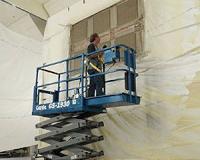
It's "Operation Insulation" for NASA's new rocket, the Space Launch System, at the agency's Marshall Space Flight Center in Huntsville, Alabama.
Steve Bray, above, a Bevilacqua Research Corp. employee supporting Marshall's Engineering Directorate, is part of a team of engineers and technicians who are preparing panels that will be used for testing foam insulation materials for SLS – the largest, most powerful launch vehicle in the world for deep-space missions, including Mars.
Different types of polyurethane-based foam will be used to protect and insulate the SLS core stage and launch vehicle stage adapter, which connects the core stage to the interim cryogenic propulsion stage (ICPS).
The ICPS will give the Orion spacecraft the big push needed to fly beyond the moon before the spacecraft returns to Earth.
Approximately 180 panels have been prepped for various tests, which are being conducted to qualify the insulation for the challenging environments SLS will experience before and during flight. The Marshall Center manages the SLS Program for NASA.
SLS Booster Work Continues Well after Smoke Clears from Major Test
Orbital ATK technicians detach the center forward segment from the forward segment of NASA's five-segment booster that fired up for testing March 11 at Orbital ATK's test facility in Promontory, Utah.
The two-minute static test was the first of two ground tests to support qualification of the boosters that will help launch the first flight of NASA's new rocket–the Space Launch System (SLS).
The most powerful launch vehicle ever built, SLS will take humans and cargo on deep space missions, including an asteroid and ultimately to Mars. Disassembly and inspection of the booster is ongoing, but preliminary analysis of the test data shows all test objectives were successfully completed during the hot fire.
The second qualification test is planned for early 2016. Once qualified, flight booster hardware will undergo final manufacturing and preparation for shipment to NASA's Kennedy Space Center in Florida for the rocket's first unmanned flight.
